By Kent Brooks
As German troops crossed into Austria, a Baca County man set out for San Francisco behind a team of oxen.
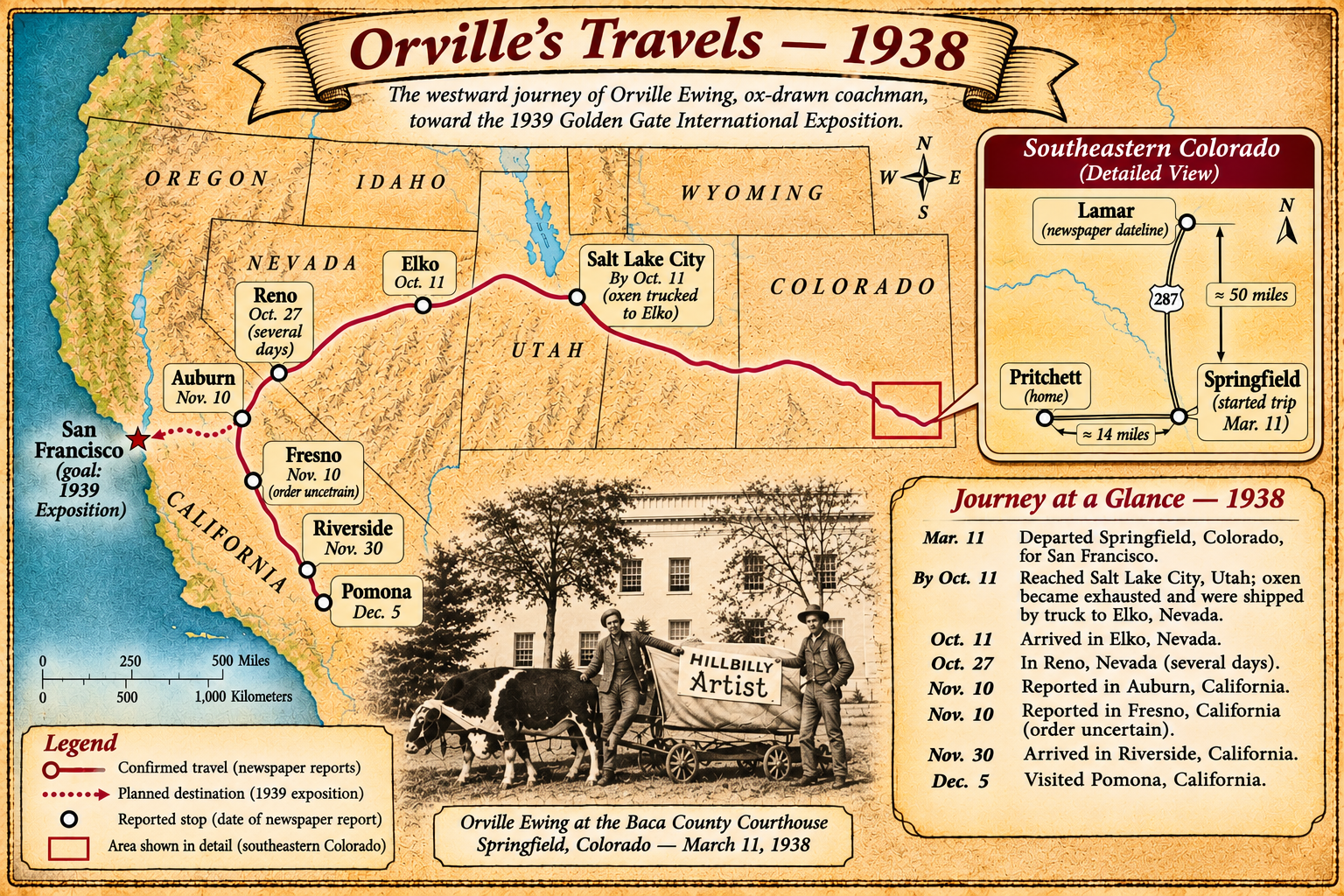
On Friday, March 11, 1938, two very different stories were unfolding thousands of miles apart. In Europe, Adolf Hitler was preparing to send German troops across the Austrian border, setting in motion events that would soon place Austria under Nazi control. In southeastern Colorado, Orville Ewing of Pritchett was beginning a considerably slower undertaking. With an ox-drawn wagon, a radio, a nanny goat, and plans to reach San Francisco in fifteen months, he was setting out on a journey that would carry him across the American West.
Both stories appeared in the Fresno Bee, offering a remarkable snapshot of the world on the day Orville’s adventure was announced. One concerned the collapse of Austrian independence and the growing threat of war in Europe. The other told of a Colorado traveler who expected to cover about 100 miles a month behind his oxen. There is no evidence that the two events had any connection, but their appearance in the same day’s news provides an interesting historical setting for the beginning of Orville’s travels.

Europe on the Brink
The European story dominated the international news. Under the headline “German Troops Pour Into Austria; Nazi Is Made Chancellor,” the Fresno Bee reported that Austrian Chancellor Kurt Schuschnigg had resigned and that Arthur Seyss-Inquart, identified as Austria’s Nazi leader, had been appointed to replace him. The developments followed an ultimatum from Hitler and mounting pressure on the Austrian government.
The Associated Press dispatch from Vienna, dated March 11, reported that Seyss-Inquart had called upon Hitler to send German troops into Austria as soon as possible, ostensibly to prevent bloodshed. Reports from Munich indicated that German soldiers had begun crossing the border shortly before midnight. Other dispatches described troops moving through Salzburg, Kufstein, and Mittenwald, while military trucks, motorcycles, artillery, and engineering units advanced toward Austria.

The newspaper conveyed a country rapidly losing control of its own affairs. German aircraft were reportedly flying over Vienna, Austrian police were increasingly aligning themselves with the Nazis, and the Nazi flag had been raised above the Austrian chancellery. Diplomatic officials in Britain and France were following the developments, but the situation was changing by the hour.
One detail in the Bee account captured the speed of the German advance. Motorists reported seeing long columns of military vehicles, while German troops requisitioned horses and automobiles and compelled local residents to assist with their movement. The border crossings were not simply ceremonial. They were accompanied by the equipment and organization of a modern military force.
The following day, March 12, German troops would continue into Austria, and Hitler would enter the country. The annexation, commonly known as the Anschluss, would be formally proclaimed shortly afterward. But readers following the news on March 11 were witnessing those developments as they happened, without knowing precisely how the crisis would end.
A Very Different Journey in Colorado
While Europe was moving toward war, Orville Ewing was preparing for a journey that seemed to belong to an earlier century. The Fresno Bee carried a short Associated Press dispatch from Lamar, Colorado, under the headline “Colorado Ox Starts Long Pull To S. F.” The story announced that Ewing, a resident of Pritchett in Baca County, had set out on March 11 in an ox-drawn vehicle mounted on balloon tires, equipped with a radio, and accompanied by a nanny goat.

His destination was San Francisco, where the Golden Gate International Exposition was scheduled for 1939. Orville hoped to arrive on June 10 of that year, carrying a letter of greeting from Pritchett Mayor Earl Deeds to exposition officials. He expected the journey to take fifteen months, averaging approximately 100 miles each month. According to the newspaper, he hoped to reach Salt Lake City by Christmas, and the goat would supply milk along the way.
The little article was brief, but it contained nearly everything necessary to make Orville’s undertaking a curiosity. At a time when automobiles, airplanes, and modern highways were changing the way Americans traveled, he had chosen a team of oxen. His wagon had rubber tires and a radio, suggesting that he was not entirely opposed to modern conveniences, even if his preferred means of transportation was decidedly old-fashioned.
The story also identified Orville as a man from Pritchett, a small community on the southeastern Colorado plains. For readers in California, it was probably an amusing account of an unusual traveler heading toward their state. For readers familiar with Baca County, it was the beginning of an adventure that would eventually become part of the region’s local history.
The World Orville Was Traveling Through
The contrast between the two newspaper stories is striking. On one side of the world, German military columns were moving across an international frontier. On the other, a Colorado man was beginning a journey measured in miles per month rather than miles per hour. One story involved governments, armies, ultimatums, and the threatened destruction of a nation’s independence. The other involved two oxen, a goat, a radio, and a letter from a small-town mayor.
The Fresno Bee also carried other stories that day, including the rearrest of New York financier Richard Whitney on theft charges and reports that railroad employees might be asked to accept wage reductions. Together, the clippings provide a useful picture of the concerns occupying newspaper readers in March 1938. International instability, financial troubles, labor questions, and the occasional oddity from the American countryside all competed for space in the same newspaper.
The coincidence becomes even more interesting when viewed from the perspective of Orville’s planned destination. The Golden Gate International Exposition was intended to celebrate progress, commerce, and connections among nations around the Pacific. Orville hoped to arrive there in June 1939, only a few months before Germany’s invasion of Poland would bring the outbreak of World War II in Europe. His journey began against the backdrop of one major international crisis and was scheduled to conclude shortly before another.

Newspaper reports later in 1938 would document his passage through Utah, Nevada, and California, including difficulties that required his oxen to be transported by truck from Salt Lake City to Elko, Nevada.
By November, he had reached California, where newspapers continued to follow his progress. His wagon, oxen, goat, and traveling companions attracted attention along the way. What had begun as a short dispatch from Lamar was becoming a continuing newspaper story.
A Date Worth Remembering
March 11, 1938, deserves a place in the story of Orville Ewing because it anchors his travels to a recognizable moment in world history. While Hitler was forcing Austria’s government to surrender its independence, Orville was beginning a journey that would take him across the western United States at the pace of an ox team.

For Orville, however, March 11 was the beginning of a long road west. He had a wagon, a team of oxen, a goat to provide milk, and a destination more than a thousand miles away. Whatever else was happening in the world, he had a journey to make.

Want to learn more about Old Boston Colorado? Find it and our other titles on Amazon:


Leave a Reply
You must be logged in to post a comment.