How Old Boston and the Jennings Clan Helped Forge the Image of the American Outlaw
By Kent Brooks
| “Old Judge Jennings was a little of everything on top of ground — a genius, a wizard, a diplomat, an orator, a doctor, a lawyer, and a good many other things all in a bunch. The old judge had the face of a weasel and the cunning of a fox. On top of it all he had brains, and controlled by those brains was a tongue that could be used to discomfiture of anyone who attempted to cross his path — when the crossing was the wrong way of the grain.” — Sam Konkel, Springfield Herald (Springfield, Colorado), March 29, 1918 |

In July 2026, the Plainsman Herald posed a provocative question that challenges conventional cinematic history: did a forgotten, violent boomtown on the Colorado plains help shape the entire genre of Western movies?
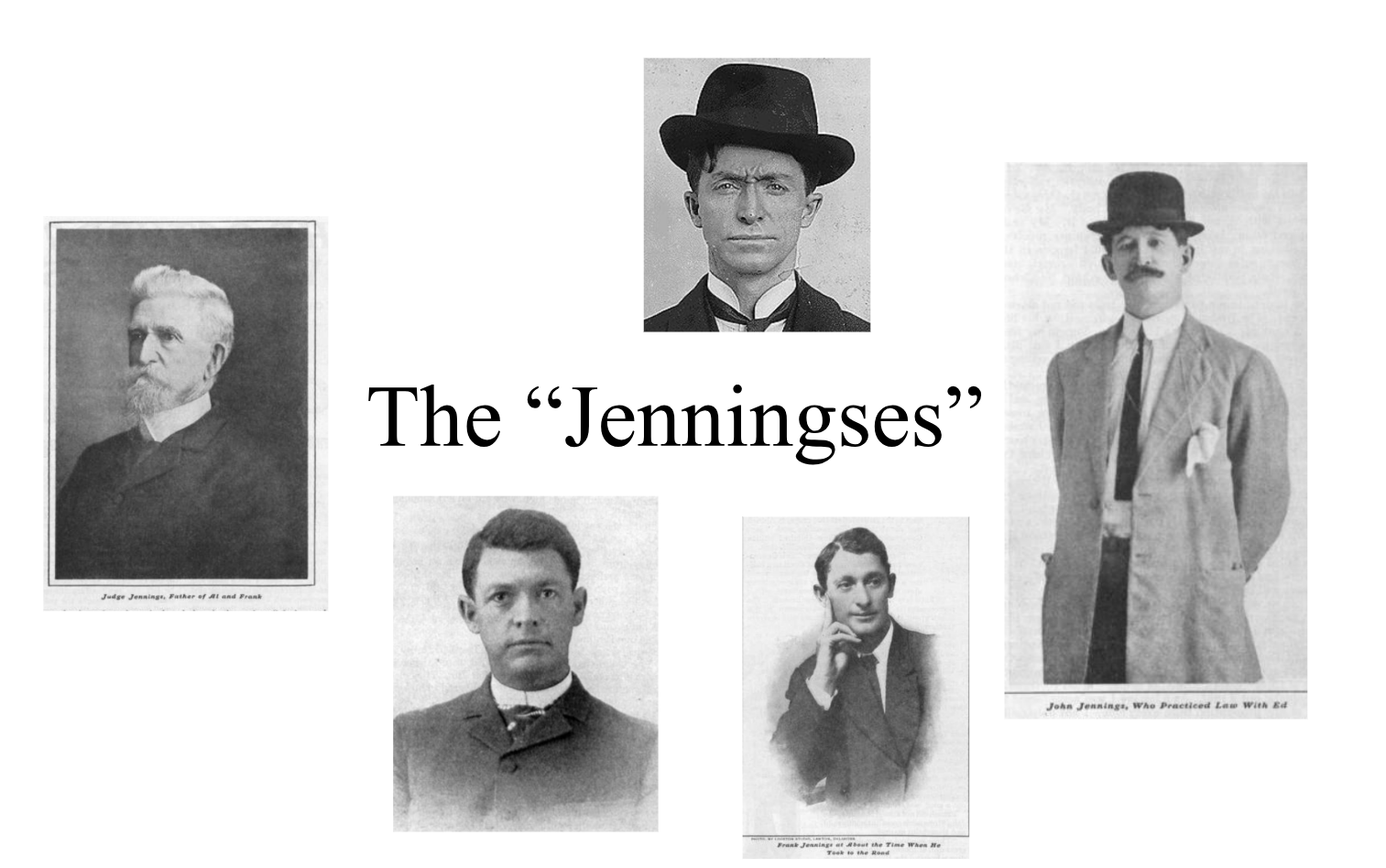
This historical narrative of the Jennings family—comprising Judge John Dela Fletcher (J.D.F.) Jennings and his sons Alphonso (Al), Edward (Ed), Frank, and John Jr.—represents a unique intersection of Western expansionism, boomtown volatility, and the birth of American cinematic mythology. Spanning from the antebellum South through the violent frontier clashes of Kansas, Colorado, and Oklahoma to the mid-twentieth-century Hollywood studio system, the family’s journey reflects the broader American transition from a loosely governed agrarian frontier to a structured, industrialized society.
Much of this complex history is preserved through the writings of frontier newspaperman Sam Konkel, editor of the Boston World (1887–1889) and later the Springfield Democrat-Herald, who frequently referred to the clan as “the Jenningses.” As Konkel observed, while the family possessed undeniable talent, charisma, and legal education, they brought an aggressive, unyielding edge to every settlement they touched: “that as long as you didn’t get in their way they were fine.” However, if anyone stood in the way of something they wanted, they were bullies who enforced their ambitions with armed intimidation and revolvers. After the demise of Old Boston, Colorado, in April 1889, the Jenningses found their way to Oklahoma Territory, where they systematically continued the exact tactics they had employed on the Colorado plains.
Biographical Overview of the Jennings Clan
| Historical Figure | Primary Frontier Roles | Documented Jurisdictions |
| Judge J.D.F. Jennings | Surgeon, Lawyer, State’s Attorney, Probate Judge, Methodist Minister, Real Estate Booster | Virginia, Illinois, Kansas, Colorado, Oklahoma |
| Alphonso (Al / Forney) Jennings | Attorney, County Attorney, Train Robber, Convict, Author, Silent Film Star, Politician | Virginia, Kansas, Colorado, Oklahoma, California |
| Edward (Ed) Jennings | Lawyer, Deputy County Attorney, Cattle Rancher, Real Estate Speculator | Kansas, Colorado, Oklahoma |
| Frank F. Jennings | Attorney, Town Company Secretary, Outlaw Gang Member | Kansas, Colorado, Oklahoma |
| John Jennings Jr. | Attorney, Vigilante Leader, Gunfight Survivor, Executive Clemency Advocate | Colorado, Oklahoma |

The Patriarchal Context: The Multifaceted Life of Judge J.D.F. Jennings
The trajectory of the family begins with the complex figure of John Dela Fletcher Jennings. Born in June 1831 in Tazewell County, Virginia, J.D.F. Jennings was a man of remarkable versatility, serving at various times as a schoolmaster, physician, Methodist minister, lawyer, and newspaper editor. This breadth of expertise allowed him to navigate the rapidly changing social landscapes of the nineteenth-century United States, though his career was frequently punctuated by sudden departures.
Before the Civil War, Jennings was established as a plantation owner in Tennessee. Upon the outbreak of hostilities, he enlisted in the Forty-first Virginia Infantry of the Confederate Army, serving as a surgeon. Al Jennings would later describe the family as part of a ‘proud class of Southerners’ who clung to a chivalrous code of honor despite the devastation of the war.
Following the war, the family migrated to Marion, Illinois, where J.D.F. Jennings became the State’s Attorney for Williamson County. His tenure coincided with the ‘Bloody Vendetta,’ a period of intense localized feud violence that earned the region the moniker ‘Bloody Williamson.’ Milo Erwin, author of the first history of Williamson County, left a vivid, unvarnished portrait of the Judge:
| “He was a professional doctor, lawyer, preacher, fiddler, horn blower and libertine. When he made music on the square, a crowd would swell around him. When he preached, they all went to hear him, from the talented aristocracy down to the bootblack. He was a rowdy among the rowdies, pious among the pious, Godless among the Godless and a spooney among the women….” — Milo Erwin, The History of Williamson County, Illinois (1876) |
Erwin noted that after preaching an impassioned sermon at the courthouse in June 1867, county records from September 1875 revealed that Judge Jennings was indebted to the local school fund for $927. By October 1877, the local paper reported he had skipped the county and was living in Rome, Ohio. By 1884, he had relocated to Coldwater, Comanche County, Kansas, where he was elected the county’s first probate judge. His influence soon extended to regional speculation; in November 1887, as a booster of Boston, Colorado, Judge Jennings served as the featured orator at a public meeting regarding the B. & M. Railroad in Holmes’ Hall.
2. Speculation and the Founding of Boston, Colorado (1886–1889)

The mid-1880s represented a period of feverish Western land speculation. The Jenningses were at the forefront of this movement, playing a central role in founding the boomtown of Boston in what is now Baca County, Colorado. Much of this history is explored in my books Old Boston: As Wild As They Come (2018) and my upcoming book The Man With Two Reputations: The Regulator Bill Thompson. In Boston, Frank F. Jennings served as Secretary of the Boston (or Atlantis) Town Company, while Judge J.D.F. Jennings served as Vice President. Al and Frank also operated a general store and opened a real estate office under the firm name Jennings Brothers.
The family balanced civic roles with aggressive political maneuvers. Frank served as deputy county clerk of Comanche County, Kansas, while his brother Forney (Al) practiced law in Coldwater. Both brothers stirred sharp controversy when they temporarily established residency in Kiowa County specifically to vote in local contests while continuing to hold property and public roles in neighboring jurisdictions.
Founded during a blizzard on November 26, 1886, Boston boomed almost overnight, boasting seventy buildings by March 1887. Yet the town was notorious for extreme lawlessness, earning the moniker “Noted Burying Ground.” A hunting party from Garden City, Kansas, visiting Boston in December 1888, documented the grim reality of the settlement: they counted 18 graves in the local cemetery—17 of the deceased having been shot and one hung.
The frontier extracted a heavy personal toll on the family as well. Edward (E.E.) Jennings had married Tena (Ettie A.) Nichols in 1884, and the couple ran a cattle ranch near Kinsley, Kansas, before seeking their fortune in Boston. Their hopes ended in tragedy when Tena contracted typhoid fever during the journey west. She survived only three days after arriving in late 1887—an event the Boston Banner remembered as one of the saddest episodes in the town’s brief history.
“Revolver Justice”: Silencing Frontier Editors
In Old Boston, the Jennings brothers established a precedent of using armed mob force to silence unfavorable press. When George Daniel, editor of the Boston Banner (1887–1889), published criticisms of their speculative dealings and political maneuvers, the Jenningses cornered and pistol-whipped him. Frontier editor Sam Konkel of the rival Boston World noted that while he avoided Daniel’s fate, the brothers’ wrath was inevitable for anyone who crossed their grain.
This was not an isolated frontier outburst, but a repeatable blueprint. Three years later, after relocating to Oklahoma Territory, the brothers deployed the identical tactic while serving as public prosecutors. The Coldwater Enterprise in Kansas documented the incident with unmistakable familiarity:
| “The Jennings boys, residents of Comanche county in the early days, are making themselves notorious in Oklahoma. Monday Forney Jennings, who is county attorney of El Reno county, and his brother Edward, who is deputy county attorney, assisted by two other parties, beat the editor of the Oklahoma Democrat, T. F. Hensley, into insensibility with their revolvers. Two of them covered the editor with their revolvers while the other two pounded him with their firearms Nobody, interfered and no arrests were made. Hensley had criticised the official conduct of the county attorney. An unarmed editor would hardly defend himself against four men and as many revolvers. These same Jennings boys assisted by two others, beat an editor at Boston, Colo., in a similar manner, several years ago.” — Coldwater Enterprise (Coldwater, Kansas), Saturday, July 1, 1893 |
The dispatch illustrates that long before the tragedy at Woodward, Al and Ed Jennings were comfortable using the badge to shield extrajudicial violence, operating with overwhelming numerical odds and cocked revolvers.

John Jennings Jr. and the Deviltry of Old Boston
The Confrontation at the Town Well
John D.F. Jennings Jr. was frequently at the center of Boston’s street conflicts, exhibiting a volatile mix of legal work and frontier vigilante action. According to Sam Konkel’s recollections, John was once delegated to ‘chastise’ local resident Bob Hambric (who later became a Las Animas County Commissioner) by the town well at 9th and Main. The encounter backfired: John threw a punch that missed, and Hambric landed a counter-blow that knocked him flat. When John reached for his revolver to strike Hambric with the butt, Tom Hambric stepped in and confiscated the weapon as “contraband of war.” John was forced to go without his gun for three days.[1]

In September 1888, John cast himself as a defender of frontier order. Following repeated stock raids by horse thieves operating out of Oklahoma’s ‘No Man’s Land,’ John led an armed posse of approximately 200 men—recruited from Boston, Springfield, Vilas, and Carriso—south across the border. Their target was a fortified redoubt in Squaw Canon. During the raid, the posse surprised Billy Cornelius, an ex-marshal of Boston who had turned outlaw, catching him and a companion drying their clothes after a rainstorm. While Cornelius leaped onto his horse bareback and escaped, John’s expedition recovered stolen stock and arms, demonstrating the porous line between frontier law enforcement and vigilante justice.
The Catalyst for Outlawry: The 1895 Woodward Shootout
After Boston burned in April 1889 following a shootout, a devastating fire, and a vetoed county-seat bill, the Jenningses left the Colorado plains broke. They re-established their legal practices in Oklahoma Territory, with Judge J.D.F. Jennings becoming Probate Judge of Woodward County and his sons opening offices in town.
On October 8, 1895, a courtroom dispute in Justice Williams’ court over a stolen keg of beer pitted the Jennings brothers against rival attorney Temple Houston (the gun-toting son of Texas hero Sam Houston). Angry insults were exchanged, and the ‘lie’ was passed. Late that evening, the feud erupted into gunfire inside Jack Garvey’s Cabinet Saloon.
As the Western Star reported, spectators rushed in to find Ed Jennings dead on the floor with a fatal head wound, while John fled up the street, bleeding in streams from a shattered arm. Temple Houston was tried and acquitted on grounds of self-defense. Embittered by the verdict, Al and Frank Jennings renounced the law, with Al publicly vowing to take to the outlaw trail to avenge his brother’s death.
Here is a little more of this story of the Jennings after their time in Boston Colorado.
AFTER BOSTON COLORADO…ED. JENNINGS KILLED AND JOHN JENNINGS WOUNDED.
The Western Star (Coldwater, Kansas) · 12 Oct 1895, Sat · Page 1
About 10 o’clock Tuesday evening last, Woodward, Oklahoma was aroused by a fusillade of shots in one of the principal saloons, known as the “Cabinet” and owned by Jack Garvey. Hastening to the scene, spectators found Lawyer Ed. Jennings weltering in his blood, his brain oozing from a bullet hole in the left rear side of his head, his hand still clinging to a smoking revolver. Lawyer John Jennings was fleeing up the street with one arm limp and dangling by his side, from which the blood poured in streams. Lawyer Temple Houston and ex-Sheriff Jack Love were on their way to the sheriff’s office to surrender their persons to his custody. The trouble arose over a dispute between the Jennings and Temple Houston in a suit the day before in Justice William’s court, when the “lie” was passed. Late in the evening Houston, accompanied by his intimate friend ex-Sheriff Love, entered the Cabinet saloon and soon after Ed and John Jennings came in. But a few words passed between them when the shooting began on both sides, Houston and Love emptying their guns and the Jen- Jennings boys doing the same. Ed. Jennings fell at the first fire, but managed to shoot once as he staggered forward to his death. After exhausting his ammunition John Jennings ran out and reached his home after fainting once from the loss of blood. He is now resting easy with every chance for recovering. John and Ed Jennings are sons of J.D. F. Jennings, now Probate Judge of Woodward county Oklahoma. Both the boys were unmarried, though Ed. was a widower and leaves a boy of 9 years. The Jennings family are well known to the early settlers of this county, they having resided here from 1884 to 1887. J. D. F. Jennings was the first probate judge elected in the county, but was defeated for a second term. John and Ed. Jennings were always considered “fighting stock’ and have figured in fights in different parts of the country, but they were badly worsted in this affray.

The Reality of the Jennings Gang: 109 Days of Bungled Crime (1897)
While Al later cultivated the persona of a master bandit in print and on screen, historical records show that the criminal career of the Jennings Gang lasted just 109 days in the autumn of 1897 and was characterized by comical ineptitude:
| Date & Location | Target & Operational Plan | Historical Outcome & Reality |
| Aug 16, 1897 Edmond, OK | Attempted train robbery; signalled train with red lantern. | Engineer ignored lantern and nearly ran Al down; gang fled empty-handed. |
| Oct 1, 1897 Chickasha, OK | Attempted safe dynamiting in Rock Island express car. | Dynamite failed to breach safe; looted passengers for whiskey and bananas. |
| Oct 1897 Berwyn, OK | Train holdup on Santa Fe line. | Gang claimed a $30,000 haul; railroad officials disputed the figure. |
| Oct 29, 1897 Cushing / Foyil, OK | Robbery of general store and post office. | Brought federal marshals in full force onto their trail. |
| Nov 30, 1897 Spike S Ranch | Shootout with pursuing law enforcement posse. | Al wounded; gang scattered in panic across the countryside. |
| Dec 6, 1897 Carr Creek | Cornered in the brush by U.S. Marshal Bud Ledbetter. | Surrendered quietly without firing a shot; spree ended permanently. |
Sentenced to life imprisonment 1899, Al was saved not by his gun, but by the brother who had stayed within the legal profession. John Jennings Jr.—still bearing the scars of the Cabinet Saloon shootout—conducted an aggressive, persistent legal campaign. John convinced President William McKinley to commute Al’s life sentence to five years, and in 1907, President Theodore Roosevelt granted Al a full presidential pardon, fully restoring his civil rights.
Fact vs. Fiction: Deconstructing the Al Jennings Legend
Al Jennings was a gifted self-mythologizer who understood how to package frontier violence for an eager Eastern and urban audience. A comparison between his memoirs and verified historical records reveals the extent of his embellishment:
| Frontier Episode / Claim | Al Jennings’ Account (Beating Back) | Historical Record & Contemporary Accounts |
| Cowboy Origins | Claimed he ran away at age 11 to become a hardened cowboy and long rider. | Sam Konkel noted nobody in Boston ever heard of Al’s cowboy past; he was remembered for school, cadet drill, and showmanship. |
| Life in Old Boston | Glossed over Boston in a couple of brief paragraphs; painted himself as a chivalrous lawyer. | Deeply enmeshed in violent town feuds; pistol-whipped editor George Daniel; left the town penniless when it burned in 1889. |
| The Push into Crime | Claimed he turned outlaw solely out of grief to avenge Ed’s murder after Houston’s acquittal. | Al and Ed had already carried out extrajudicial gun assaults, including beating editor T.F. Hensley in El Reno two years prior to Woodward. |
| Train Robbery Mastery | Described himself as a fearless dynamiter and daring outlaw leader. | The gang operated for only 109 days; trains ran past him, dynamite failed to breach safes, and he fleeced passengers for fruit. |
| Invincible Gunfighter | Maintained an invincible persona; sued The Lone Ranger radio show in 1945 for airing an episode where his gun was shot away. | Jennings lost the suit to an amused jury; his actual encounters ended with bullet wounds at Spike S Ranch and surrender at Carr Creek. |
| 1951 Biopic (Al Jennings of Oklahoma) | Loudly disowned the Columbia film as an inaccurate ‘disgrace to the old West.’ | The film simply utilized the same romanticized ‘noble outlaw’ melodrama that Al himself had spent four decades marketing. |
Packaging the Myth: From Charles M. Russell to the Silver Screen
Upon receiving his presidential pardon, Al Jennings realized that while the frontier was closed, the market for frontier nostalgia was limitless. He pioneered the transition of real-life outlaws into mass entertainment:
- Staging Authenticity (1908): Al made his film debut in The Bank Robbery, produced by former frontier lawman Bill Tilghman. By casting real outlaws and lawmen to stage holdups on location, the film brought a raw, documentary realism to early cinema.
- High-Culture Serialization (1913): Partnering with journalist Will Irwin, Al serialized his autobiography Beating Back in The Saturday Evening Post. Crucially, the series featured illustrations by Charles Marion Russell, the premier Western painter of the era, giving Al’s self-aggrandizing tales national prestige.
- The ‘Bad Boy’ Gubernatorial Race (1914): Al translated his pop-culture stardom into politics, running for Governor of Oklahoma. Campaigning as the reformed rebel who had stood up against corrupt authority, he embodied the ‘bad boy who makes good,’ finishing a surprisingly strong third in the Democratic primary.
- Hollywood Technical Advisor: Relocating to California, Al starred in and directed silent films (The Lady of the Dugout, Fighting Fury) and served as a technical advisor on over 100 productions, coaching directors on authentic saddle rigging, leather holsters, and gun handling.
The Noble Outlaw Archetype and the Influence of Old Boston
This theory—first posited by the Plainsman Herald in “Boston, Colorado: Did a Forgotten Town Influence the Entire Genre of Western Movies?”—argues that Old Boston was not merely an obscure frontier footnote, but the foundational crucible for Western cinema’s core mythology. By tracing the migration of former Boston residents directly to early Hollywood sets, the inquiry suggests that the boomtown’s combustible mixture of fraudulent land promotions, saloon brawls, and extrajudicial “revolver justice” provided the authentic raw material for what became Hollywood’s most enduring storytelling tropes.
The combination of Old Boston’s chaotic history and Al Jennings’ curated memoirs helped codify the “Noble Outlaw” archetype that dominated twentieth-century Western cinema. This archetype is defined by five central cinematic conventions:
- Moral Code: Operating outside the law while adhering to a strict personal sense of justice and fairness.
- Rebellion Against Corruption: Portraying banditry as an honorable reaction against predatory syndicates, crooked lawmen, or railroad monopolies.
- Sympathy and Heroism: Framing outlawry as a fate forced upon an honorable man by tragedy.
- Depth and Complexity: Replacing two-dimensional villainy with conflicted, tragic anti-heroes.
- Fraternal Loyalty: Prioritizing family honor and comrades above formal statutes.
If the theory holds true films rrom Jesse James and Billy the Kid to Butch Cassidy and the Sundance Kid and Clint Eastwood’s The Outlaw Josey Wales, Hollywood drew continuously from the themes that Al Jennings had lived in Colorado and sold to the studios.
Historiographical Note: Talbot Jennings and The Sons of Katie Elder
Some popular accounts attempt to link the family’s cinematic imprint directly to Talbot Jennings, the celebrated, two-time Oscar-nominated screenwriter (Mutiny on the Bounty, Anna and the King of Siam). Talbot adapted Al Jennings of Oklahoma for Columbia Pictures in 1951 and provided the original story for the 1965 John Wayne Western The Sons of Katie Elder.
The narrative of The Sons of Katie Elder—four brothers reuniting at their family ranch to confront injustice and avenge a father’s murder—exhibits an unmistakable thematic parallel to the four Jennings brothers (Al, Ed, John Jr., and Frank) and the tragic 1895 shootout that shattered the family. However, critical historical rigor requires separating documented facts from romanticized lore:
- No Verified Kinship: Despite sharing a surname, there is no verified genealogical evidence proving Talbot Jennings was a blood relative of Judge J.D.F. Jennings or the Oklahoma brothers. ‘Jennings’ was a widespread Anglo-American surname, and Talbot was a top-tier studio contract writer.
- Studio Assignment vs. Family Lore: Talbot’s work on the 1951 biopic was a standard studio assignment rather than a personal passion project (a film Al loudly condemned).
- Thematic Parallel, Not Memoir: While the four-brother revenge plot of The Sons of Katie Elder mirrors the Jennings family dynamic, no archival records or interviews indicate Talbot consciously based the Elder family on the Jenningses. It stands as a striking coincedence within the genre rather than an established family memoir.
Conclusion: The Real Frontier Architect
The true historical significance of the Jennings family does not depend on unverified screenwriting ties. It rests on what Al Jennings and his brothers accomplished in plain sight: they recognized before almost anyone else that the violence of the American frontier could be commodified and sold as entertainment.
Ultimately, history allows you to read whatever you want into the Jenningses. Hollywood saw chivalrous knights of the plains; Al saw a misunderstood crusader; dime novelists saw daring train robbers. But the court dockets, municipal disputes, and frontier newspapers reveal the unvarnished historical reality: they were educated, credentialed men who used the law when it served them, and raw violence when it didn’t. They were lawyers and thugs… you can read whatever you want into that.
From the dusty town lots and pistol-whippings of Old Boston to the bloody floorboards of the Cabinet Saloon, the serialization in The Saturday Evening Post, and the soundstages of early Hollywood, the Jennings clan lived the frontier’s rawest violence and then helped author its enduring myth. Through Al Jennings’ instinct for self-promotion and visual drama, the volatile reality of an erased Colorado boomtown became the permanent mythology of the American West.

Primary Sources and Historiographical References
- Austin, J.R. (1936). An Early History of Baca County. Privately published.
- Brooks, Kent. (2018). Old Boston: As Wild As They Come. High Plains Historical Series.
- Coldwater Enterprise (Coldwater, Kansas). ‘The Jennings Boys,’ July 1, 1893, p. 2.
- Erwin, Milo. (1876). The History of Williamson County, Illinois: From Its Earliest Settlement to the Present Time. Marion, IL.
- Jennings, Alphonso J., and Will Irwin. (1913–1914). Beating Back. Serialized in The Saturday Evening Post; published as a monograph by D. Appleton & Company (New York, 1914), illustrated by Charles Marion Russell.
- Konkel, Sam. Editorials, municipal sketches, and reminiscences in the Boston World (1887–1889) and the Springfield Democrat-Herald / Springfield Herald (1913, 1918–1919).
- The Western Star (Coldwater, Kansas). ‘Ed. Jennings Killed and John Jennings Wounded,’ October 12, 1895.
- United States Department of Justice & Executive Office of the President. Executive Clemency Records: William McKinley Commutation (1904) and Theodore Roosevelt Full Presidential Pardon (1907) for Alphonso J. Jennings.
- Plainsman Herald. (2026). “Boston, Colorado: Did a Forgotten Town Influence the Entire Genre of Western Movies?” (July 2026). Available online: https://plainsmanherald.com/2026/07/boston-colorado-did-a-forgotten-town-influence-the-entire-genre-of-western-movies/
- Al Jennings – CooperToons, accessed February 21, 2026, https://www.coopertoons.com/caricatures/aljennings_bio.html
- Western Americana: History of the American West: December 2009, accessed February 21, 2026, http://westernamericana2.blogspot.com/2009/12/
- Al Jennings – True West Magazine, accessed February 21, 2026,
- Jennings, Al 1863-1961, Lawyer, Bandit, Silent Movie Actor, Author, accessed February 21, 2026, https://www.mihp.org/2013/09/jennings-al-1863-1961/
- Al J. Jennings. – RootsWeb, accessed February 21, 2026, http://sites.rootsweb.com/~oktttp/history/volume_4/al_j_jennings.htm
- Romancing the Robber | The Saturday Evening Post, accessed February 21, 2026, https://www.saturdayeveningpost.com/2014/12/romancing-robber/
- The Founding of Boston, Colorado – 1886 – Plainsman Herald, accessed February 21, 2026, https://plainsmanherald.com/2025/06/the-founding-of-boston-colorado-1886/
- r •oun ~ – History Colorado, accessed February 21, 2026, https://www.historycolorado.org/sites/default/files/media/document/2018/ColoradoMagazine_Spring-Summer1978.pdf
- The Noted Burying Ground: Boston, Colorado – Plainsman Herald, accessed February 21, 2026, https://plainsmanherald.com/2019/02/the-noted-burying-ground-boston-colorado/
- Springfield Democrat Herald (Springfield, Colorado) April 5, 1918.
- Brooks, Kent. (2018). Old Boston: As Wild As They Come.
- Brooks, Kent. (Forthcoming). The Man With Two Reputations: The Regulator Bill Thompson.

Want to learn more about Old Boston Colorado? Find it and our other titles on Amazon:


Leave a Reply
You must be logged in to post a comment.