In 1888, while the little town of Boston was fighting for survival on the southeastern Colorado plains, newspaperman and town booster Sam Konkel chose a confident motto for his Western World:
“Railroads A Moral Certainty.”
Promotional ad for Boston in the Boston World, (Boston, Colorado) March, 1888. Note the statement “Railroads a Moral Certainty.
There was considerably more certainty than railroad.
For the founders of Boston and the other boomtowns scattered across southeastern Colorado and southwestern Kansas in the late 1880s, getting a railroad ranked alongside winning the county seat as one of the great necessities of survival. A town could have stores, houses, newspapers, land companies and ambitious promoters, but without transportation connecting it to distant markets, its prospects were limited. The railroad could bring settlers and merchandise in and carry cattle, stone and agricultural products out.
Everybody knew it. Consequently, almost everybody claimed a railroad was coming.
The Seward County Courant described a September 1887 gathering at Woodsdale, Kansas, attended by representatives from Seward, Stevens and Morton counties in Kansas and from eastern Colorado. The purpose was to organize efforts to attract one of three competing railroads believed to be headed toward southwestern Kansas. Springfield, Woodsdale, Richfield and Boston were among the towns hoping to land a line.
The newspaper couldn’t resist taking a shot at rival Hugoton, where an earlier railroad meeting supposedly became considerably more ambitious after the participants had “filled themselves up with Hugoton whisky.” By the end of that meeting, according to the Courant, they had decided to build their own railroad, elected officers and filed a charter—even though the promoters supposedly did not represent $25,000 among themselves.
The humor concealed something serious. Railroads could determine which of these young towns lived and which disappeared.
Boston’s promoters understood that. When they weren’t promoting their town at home, they attended railroad meetings in Trinidad, Lamar, Richfield and elsewhere. Proposed lines appeared on maps. Railroad representatives visited. Surveys were promised. Newspapers reported each development with mounting enthusiasm.
At one point the Trinidad Daily Citizen, quoting the Boston Banner, reported that J. L. Palmer of the Rock Island had spent several days at Boston and addressed an enthusiastic meeting. The prediction that followed was remarkably confident:
“Suffice to say now that a Rock Island survey will pass through Boston within fifteen days.”
Railroads were a rallying cry for these 1880s boom towns. An ad by the Boston Company in the Greensburg, Kansas Rattler in 1887 proclaimed the following:28
Better yet, the newspaper suggested the railroad might be completed all the way to Trinidad within six months.
It wasn’t.
Every Town Had a Railroad—On Paper
Looking back some thirty years later, Konkel recognized the absurdity of the railroad fever that had swept the country.
“The two things of these old days that had the certainty of the sun rising and setting,” he wrote, “were rains and railroads.”
Then came the punch line:
The Leader-Democrat (Richfield, KS) Jun 1888, Page 3
“Every town in the east end had them—railroads, none less than two or three.”
The list was impressive: Rock Island, Santa Fe, Colorado and Southern, Denver and Gulf, Missouri-Kansas-Texas, Wichita and Western and several others. On paper, southeastern Colorado was becoming a railroad crossroads.
Perhaps the most ambitious was the Boston, Trinidad and Western, or B.T. & W.
Konkel recalled that the enterprise originated in Trinidad and was promoted by Judge J.D.F. Jennings and Albert Hughes, president of the Atlantis Town Company. The public was told the line was being promoted under Rock Island authority and would be taken over by that railroad once it had been graded.
This one at least got as far as a survey.
According to Konkel, surveyors started at the state line and, after about three weeks, “drove the last stake at the Trinidad end of the line.”
And that was about as close as Boston came.
The boom collapsed, Boston disappeared, and the railroad that Konkel and his fellow promoters had regarded as a “moral certainty” never reached their town.
But the railroad story of Baca County wasn’t over.
It was just going to take nearly forty years.
The Railroad Finally Comes
In 1926, the long-awaited east-west railroad finally reached Baca County. The Santa Fe pushed its line westward from Kansas through the county, connecting communities including Walsh, Springfield and Pritchett with outside markets.
For an agricultural county, the significance was enormous.
The Wall Street Journal (New York, New York) · Mon, Apr 27, 1908 · Page 6
The irony would have been difficult for Konkel to miss. The railroad that had been promised almost daily during the boom of 1887 and 1888 had finally arrived—but the town of Boston had been gone for decades.
And within only a few years, Baca County was talking about another railroad.
“Another Railroad for Baca County”
In February 1931, the Hooker Advance carried a story under a headline that would have sounded familiar to anyone who had lived through the 1880s:
“ANOTHER RAILROAD FOR BACA COUNTY, COLO.”
The proposed Santa Fe extension would run from Boise City, Oklahoma, north to Las Animas, creating a second major rail corridor through the county.
Once again, railroad excitement swept the towns.
Campo and Edler hoped to benefit. Pritchett expected the new line to follow its direction, while Springfield argued that the Santa Fe should come through there instead. The newspaper predicted that the railroad would open a large portion of southwestern Baca County to settlement and development.
Its conclusion carried all the optimism of the old Boston days:
“The Santa Fe made Baca county and there is no reason to doubt that its second line will help in the development of this fruitful area.”
Then the plans became even more interesting.
Two New Towns
By December 1931, newspapers weren’t merely talking about a railroad. They were talking about new towns.
The Texas County News of Guymon reported on December 17 that Santa Fe had purchased a quarter section—160 acres—approximately 25 miles northwest of Springfield for a townsite.
The land was in the Butte Creek region, the newspaper said, and preliminary work had begun.
Guymon Daily Herald (Guymon, Oklahoma) Dec 24, 1931,Page 10.
A week later, the Guymon Daily Herald reported that two new towns would spring up in Baca County with construction of the Amarillo-Las Animas cutoff.
The first was the 160-acre Santa Fe property northwest of Springfield. Engineers were expected to begin laying out the town, although:
“The name of the station has not yet been chosen.”
The second is considerably more mysterious.
“Another town,” the newspaper reported, “will grow around what is now known as Little Kansas.”
A Kansas townsite company was reportedly completing plans to plat it.
For a county that had been watching towns appear and disappear since the 1880s, it must have sounded familiar.
But this time the railroad really was coming.
Then the Depression and the Dust
The timing could hardly have been worse.
The optimism of 1931 ran headlong into the Great Depression and then the drought and blowing soil of the Dust Bowl. Railroad construction did not proceed on the timetable imagined in those early reports.
The north-south line was finally completed in 1936 and placed into operation in 1937, after some of the hardest years Baca County had ever endured.
That makes the railroad particularly significant in the agricultural history of the county. The east-west railroad of 1926 had already given farmers much better access to national markets. Now a second line provided a north-south connection between Boise City and Las Animas, tying Baca County into routes extending toward Amarillo to the south and the larger Santa Fe system to the north.
For wheat, broomcorn, livestock and the other products upon which the county depended, those rails were connections to markets far beyond the High Plains.
And when the line finally opened, some of those mysterious places discussed back in 1931 had names.
Frick, Ramp and Bisonte
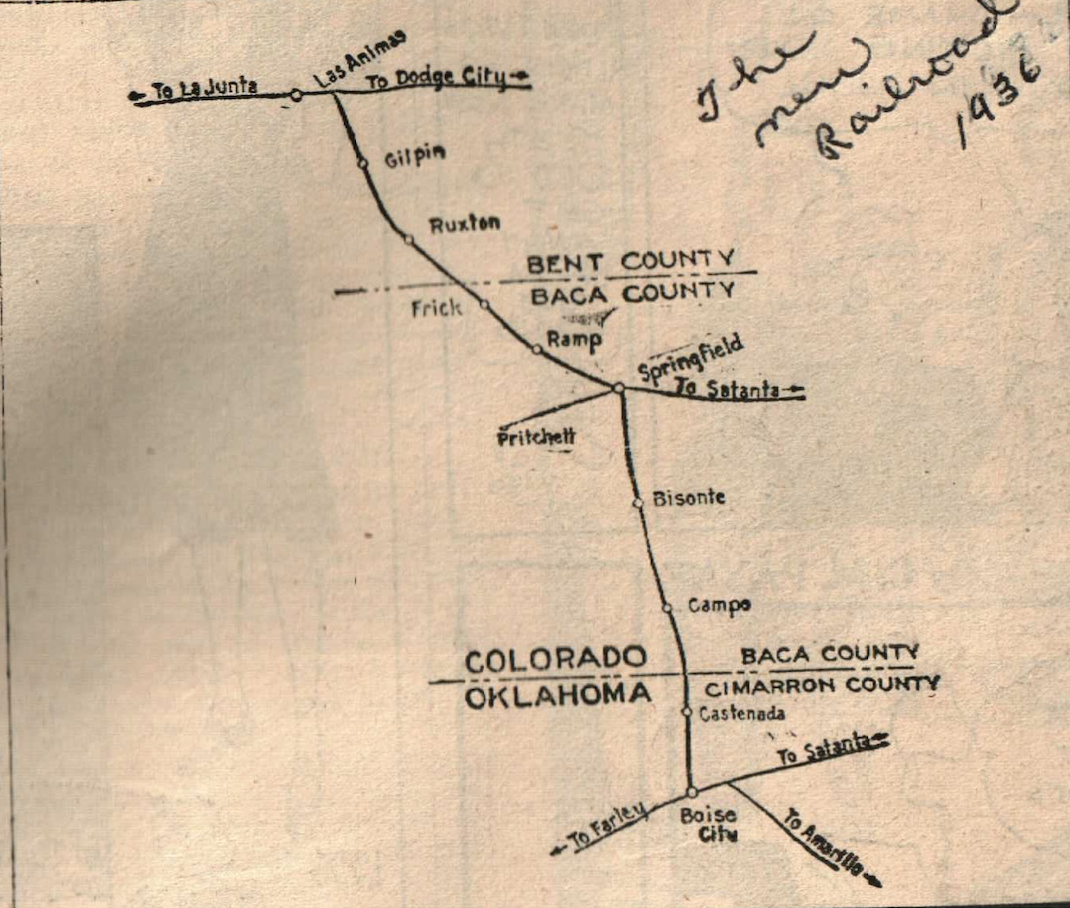
A newspaper map published in 1937 shows the completed route entering Colorado from Cimarron County, Oklahoma, passing through Campo and Bisonte, reaching Springfield, then bending northwest through Ramp and Frick before continuing through Ruxton and Gilpin toward Las Animas.
The same contemporary account identified three new stations in Baca County:
The Altus Times-Democrat (Altus, Oklahoma) Jan 3, 1937 · Page 4
Frick, Ramp and Bisonte.
We can now locate them with considerably more precision than the little 1937 newspaper map allowed.
Bisonte was in Section 15, Township 32 South, Range 46 West, about ten miles south of Springfield.
Ramp, also known as Harbord, was in Section 28, Township 29 South, Range 48 West, approximately ten miles northwest of Springfield.
Frick was farther northwest, in Section 30, Township 28 South, Range 49 West, described in later records as seventeen miles northwest of Pritchett.
For comparison, Springfield was in Section 29, Township 30 South, Range 46 West, while Pritchett, fourteen miles west of Springfield, was in Section 6, Township 31 South, Range 48 West. Pritchett remained connected to Springfield by the earlier east-west Santa Fe line rather than lying directly on the new north-south route.
North of Baca County, the new line continued to Ruxton, Section 28, Township 26 South, Range 51 West, and Gilpin, Section 24, Township 24 South, Range 52 West, about nine miles south of Las Animas.
Put those locations on a map and the crude little drawing published in 1937 turns out to tell the story rather well. From Springfield the old line runs west toward Pritchett and east toward Satanta, Kansas. The new railroad turns northwest toward Ramp and Frick and south through Bisonte and Campo toward Boise City.
After nearly half a century of railroad dreams, Baca County had become the railroad crossroads its earliest promoters had imagined.
Just not quite where they had imagined it.
Was the Unnamed Town Frick?
There is another tantalizing connection between the newspaper reports of 1931 and the completed railroad of 1937.
Remember the 160 acres Santa Fe purchased for an unnamed town?
The newspaper placed it approximately 25 miles northwest of Springfield in the Butte Creek region. Six years later, Frick stood on the new railroad in that same general country.
That makes Frick the strongest candidate for the unnamed Santa Fe townsite of 1931.
But there is an important distinction between evidence and certainty. The 1931 newspaper does not call the place Frick. Unless a deed, railroad record, plat or another contemporary source establishes the connection, it should remain a probable identification rather than a proven one.
And then there is Little Kansas.
Where Was Little Kansas?
For now, this may be the best mystery in the story.
The December 1931 newspaper plainly reported that another town was expected to develop around a place “now known as Little Kansas.”
But where was it?
There is a Little Kansas Cemetery at approximately 37.9400, -102.8280, well to the north in Bent County. Its name is intriguing, but nothing found so far establishes that the cemetery marks the Little Kansas referred to in the Baca County railroad story.
That distinction matters because the newspaper specifically described the proposed development as one of two new towns in Baca County.
Perhaps another clipping will turn up. Perhaps a townsite plat survives in courthouse records. Perhaps “Little Kansas” was a local name so familiar in 1931 that the newspaper saw no reason to explain where it was.
For now, its location remains unknown.
From “Moral Certainty” to Steel Rails
There is a remarkable symmetry to the story.
In 1888, Sam Konkel proclaimed railroads a “moral certainty” while Boston’s boosters chased railroad representatives, attended meetings and printed proposed routes. Survey stakes were driven across the country, newspapers predicted construction within months, and nearly every aspiring town claimed two or three railroads headed its way.
Most never came.
Springfield Democrat Herald. February 4, 1937
Nearly forty years passed before the east-west railroad finally crossed Baca County in 1926. Less than a decade later came plans for another great connection, this time running north and south. Even that project took years longer than its boosters expected, finally becoming a reality in 1936–37.
By then Boston was gone. Some of the other towns whose promoters had fought so hard for a railroad were gone too.
But Springfield survived. So did Campo, Pritchett, Vilas and Walsh. And along the new line appeared three names that would probably puzzle many Baca County residents today:
Frick. Ramp. Bisonte.
They were the Baca County towns the railroad built—or at least tried to build.


Leave a Reply
You must be logged in to post a comment.