The Life and Legacy of Cowboy Fred Holister
By Kent Brooks

Great journeys into the past starts with a single question. For this story that question came a few years back (maybe 2015 or 2016) during a visit with my Uncle Harold Brooks. As we sat talking about the old stories and forgotten histories of Baca County, Colorado, he asked if I had ever run across the name Fred Holister.
At the time, I hadn’t. But that is how these historical tales work—once a name is spoken, my eyes start to look for it, and the archives somehow seem to have a way of answering. Sure enough, hidden away in an old notebook at the Baca County Museum, I uncovered a handwritten biography of Fred.

When I brought a copy of that post to Uncle Harold, it unlocked a wonderful memory from his boyhood growing up in Vilas.
Uncle H. recalled Fred as an elderly man, getting up in years but still carrying the unmistakable steel of a lifetime on the range. One afternoon, Fred was at the Vilas pool hall when a disagreement flared up . The other man, sizing up Fred’s age, sneered: “If you weren’t an old man, I’d give you a whipping you won’t forget.”
Without missing a beat, the old cowboy looked him dead in the eye and replied:
“Don’t let a few gray hairs get in the way of your courage.”
It is a line straight out of a classic Western. Fred was utterly unfazed by a young challenger’s threats? To find the answer why, you have to look at the men Fred rode with in his youth. The young bully in the pool hall had no idea that the elderly man standing before him had spent his life rubbing shoulders with some of the toughest characters in Southeast Colorado.
Standing Shoulder-to-Shoulder with Killers
To understand Holister’s composure, we only have to look at a historic 1891 photograph known as “A Cowboy Funeral”. Taken during a roundup in Baca County Colorado, the photo captures a group of cowboys paying their last respects to a drowned hand named George Brenton.

It was a pretty tough group overall, but standing in that very lineup, just a couple men away from Fred Holister, was a man named Big Bill Thompson.

Thompson was the “JJ Regulator and all-around killer” for the Prairie Cattle Company, acting as the personal bodyguard for the company’s managers. Thompson lived and died by the gun, and his reputation was terrifying:
- The Squaw Canyon Back-Shooting: In 1887, Thompson shot a man named Phillips in the back after dark while Phillips was simply dipping a bucket into a spring to get water for his supper.
- The Boston Killing: That same year, Thompson shot and killed Henry Savoie in the town of Boston, Colorado.
- Shooting Boston Off the Map: In April of 1889, Thompson was one of the gunmen who famously “shot Boston Colorado off the map”.
The stories above are recorded in my book “Old Boston: As Wild As They Come.” However, there is another book’s worth of Thompson’s story (Yes I have again started working on that one again), but Thompson eventually met his end in a November 1891 gunfight at Higbee, Colorado, at the hands of Kid Doss. But for years, Fred Holister rode, worked, and stood alongside men of this lethal caliber. He had seen real, sudden death up close. A heated argument in a local pool hall was nothing compared to the men Fred Holister had ridden with and survived.
Tracing the Trail: My Journey to Letters from Montana
As I studied Fred’s handwritten biography, one line in particular lead me down another path: “he trailed cattle to Montana for the OX.”
That detail set me on yet another quest. I wanted to know what it was like for Fred and his crew to turn north and drive thousands of head of cattle north into the vast, unfamiliar territory of Big Sky Country. What did they see? What hardships did they endure as the open range era began to fade? Specifically… would I be able to find any additional mentions of Fred Holister.

This historical detective work prompted me to trace the old trails, dig through dusty archives, and read the letters of those who made the journey. That journey of discovery ultimately culminated in my book, Letters from Montana: Stories and Incidents on the Trail in 1889. Compiling that book was my effort to physically and historically track Fred Holister on the trail, bridging the gap between a family memory in Vilas and the great northern cattle drives of the late 19th century. Did I find what I was looking for? Not really, but again another great learning experience.
From the Iowa Plains to the J.J. Ranch
Fred’s long journey to the Colorado frontier began in Shellsburg, Iowa, where he was born on November 26, 1857. By 1882, when Baca County was still officially a part of Las Animas County, he had made his way west to work as a cowboy .
By his own account, Fred started working for many of the cattle outfits of the area including the sprawling J.J. Ranch at an incredibly young age—an operation so massive that it once owned a staggering 90,000 head of cattle. He also rode for the famous 101 Ranch, gaining a hard-knocks education in survival, horsemanship, and the relentless demands of the open range.
Trailing Through No Man’s Land
Holister was a veteran of the grueling, dusty miles of the great northern cattle drives. He trailed cattle north to Montana for the OX outfit [5, 26], and recalled driving a herd with the OK Cattle Company all the way from San Antonio, Texas, to the Black Hills of the Dakotas [7].
That legendary route took Fred and his crew straight through the infamous strip of territory known as “No Man’s Land” in Oklahoma. Lacking any formal law, this tract of land was occupied by outlaws and desperados who operated armed toll gates [8]. They demanded 5 cents a head upon entering for “guaranteed protection,” and another 3 cents to leave [8].
If a trail boss refused to pay the 8-cent toll, their only options were to take a grueling 187-mile detour or risk certain death and the loss of their herd. For cowboys like Fred Holister, navigating these lawless borders and facing down armed outlaws was just part of the job.
Death on the Range
The frontier was a place where life was cheap and tragedy was never far away. During fall roundups, Fred witnessed the fatal consequences of frontier disputes. He recalls a cowboy named Johnnie Gipson of the ZH and Bud Thomas of the OX who were assigned to ride together. Bud had warned Fred that they weren’t getting along, so Fred reassigned them and gave Thomas a new horse.
But when Thomas led the horse past Gipson, Gipson made a biting remark about working for a company and not owning his own mount. After exchanging curses, Thomas threatened to kill Gipson. Gipson advanced, reaching into his shirt as if drawing from a shoulder holster to stage a bluff. Thomas fired, missing on purpose to warn him, but Gipson kept coming. Thomas fired again, killing him instantly. Gipson’s gun was later found still tucked safely in his blankets—he had died trying to bluff a man who didn’t bluff. Thomas immediately left the country to avoid standing trial, leaving Fred to handle the aftermath.
Other deaths were silent and tragic. In 1891, cowboy George Brenton drowned in West Carrizo Creek during a roundup. Fred, who at the time was working for Tom Goodwin’s TH outfit, stood alongside his fellow hands to bury Brenton in a small cemetery of seven graves, covering him with waist-high rocks to keep the wolves away.
A passing photographer captured that solemn moment in the famous “A Cowboy Funeral” photograph. If you look closely at that historic photo, Fred Holister is the only cowboy with his pants tucked into his boots.
Fred’s biography says he was wagon boss on another roundup when a cowboy drowned, and the crew had to tie heavy rocks to their ropes just to drag his body from the deep water.

The Last Roundup
In July of 1900, at the age of 43—and by his own admission, “tired of eating his own cooking”—Fred married Fannie Nefitt of Metcalf, Oklahoma. They eventually settled down on a ranch near Vilas, where they were a big part of the community.
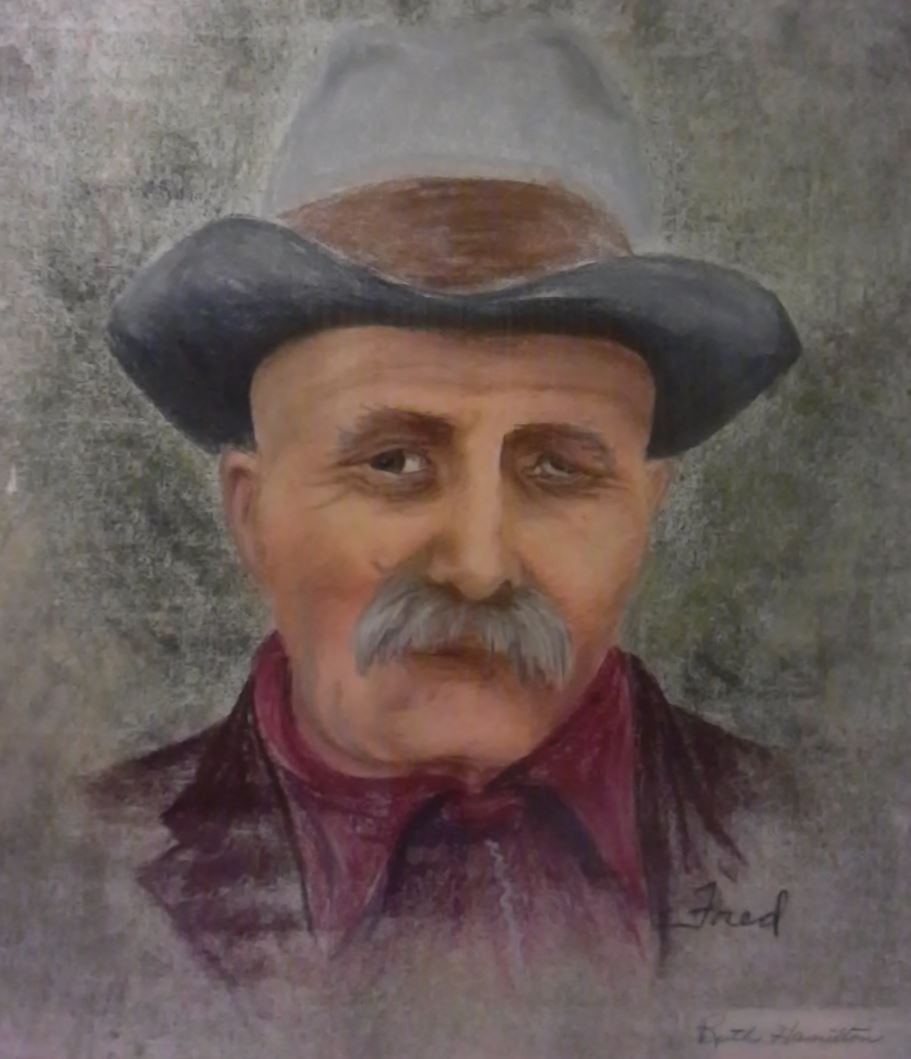
Thank you, Kathy Maestas, for the paintings of Fred and Fannie Holister (see below) it makes the story of this cowboy so much better!


Even as an 83-year-old living quietly in town, the old range boss couldn’t shake the cowboy life; his biography notes that he still got “itchy feet” whenever he saw a large herd of cattle.
Fred passed away and was laid to rest in the Old Boston Cemetery next to his wife and son. At his funeral, John Havens, who was just starting his ministry told me during a 2017 interview that he, sang “I Heading for the Last Roundup,” an old Gene Autry tune.
It was a fitting farewell for a true plains pioneer. When Uncle Harold recalled that moment in the Vilas pool hall, we both commented: “I do have a feeling he could back up those words!” Looking back at Fred’s life, stood shoulder-to-shoulder with regulators and killers, staring down outlaws in No Man’s Land, and surviving the brutal realities of the trail, we know without a doubt that Fred Hollister could back up every single word. Far from a sign of weakness, those ‘gray hairs’ were the seasoned marks of a man who had weathered it all.
Want to learn more about Old Boston Colorado? Find it and our other titles on Amazon:


Leave a Reply
You must be logged in to post a comment.