A Little History from Our Neighbors to the South and East
By Kent Brooks
Our Baca County neighbors have some interesting stories of their own, and fairly often, my research takes me across the state line. This particular story came about while I was researching The Man with Two Reputations, my book about the regulator Big Bill Thompson and the events surrounding his death in southeastern Colorado in 1891. As I worked through old newspapers from the late 1880s, part of the story resided in southwestern Kansas and the Neutral Strip, the narrow stretch of country we know today as the Oklahoma Panhandle.

One item which caught my attention was what the people living in the Neutral Strip called themselves. They were “Strippers,” and they seemed rather proud of it. There was even a place called Stripperville.

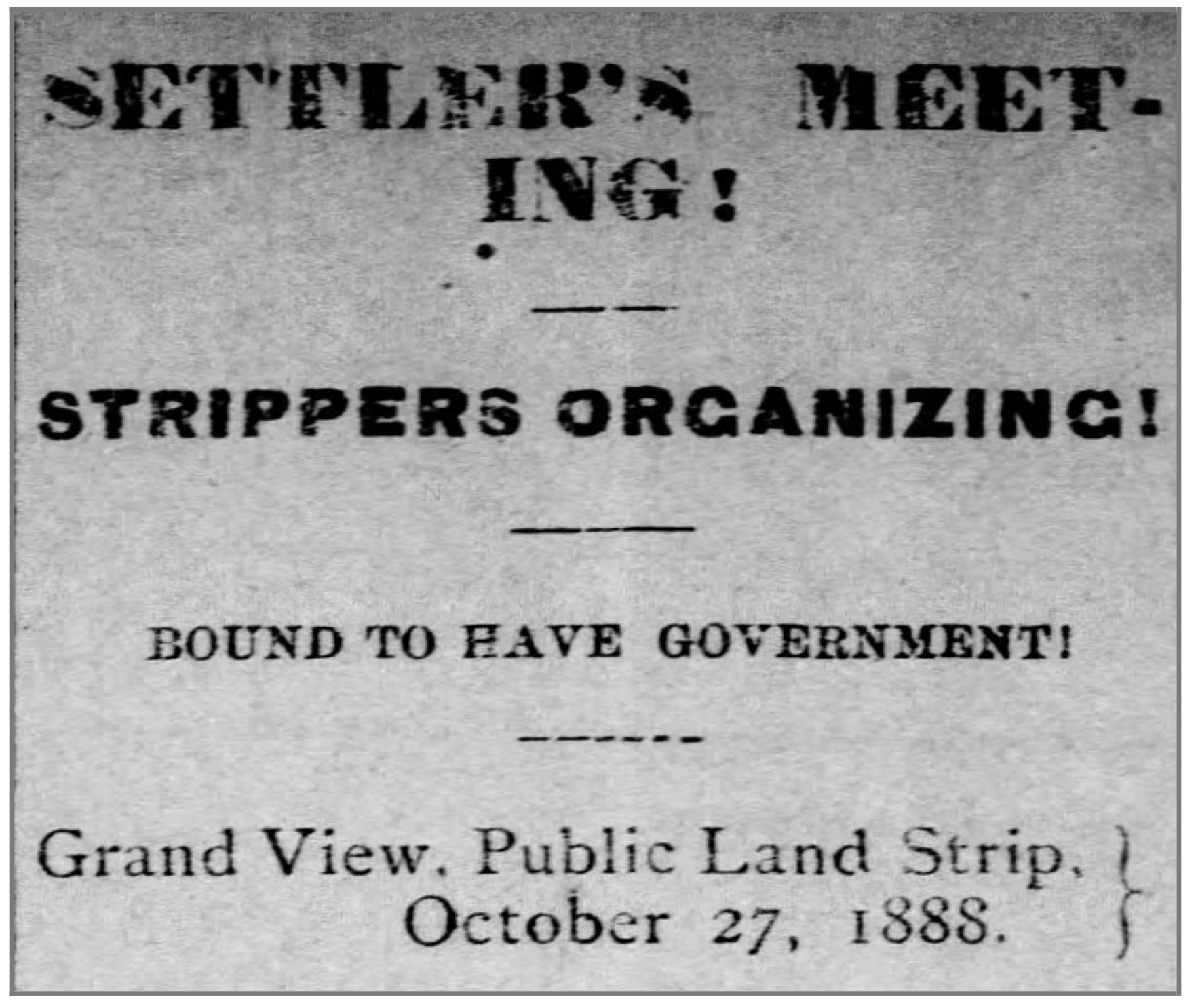
“Settler’s Meeting! Strippers Organizing!” concerning the proposed Shade County.
This is as much a southwestern Kansas story as it is a Neutral Strip story, partly because of the Shollenbarger family. Sam Shollenbarger lived in Stripperville, while another member of the family, Benton Shollenbarger was the editor of The Seward County Democrat in Fargo Springs, Kansas. The newspaper regularly reported on Sam’s trips to Liberal, where he sold bones and other goods gathered on the plains. One account even describes a St. Louis newspaper correspondent arranging to have Sam and his donkey team photographed. These family connections help explain why the newspaper provides such a remarkable record of everyday life in the Neutral Strip. The more I read, the more interesting the connections between these neighboring communities became.

One of the enjoyable things about historical research is that you seldom find only what you are looking for. Sometimes the stories you stumble across are worth telling in their own right. I had accumulated quite a collection of these newspaper accounts while working on The Man with Two Reputations, and much of it had little to do with Big Bill Thompson. Still, it was too interesting to discard, and I figured there was no sense letting all that research go to waste. So, we’re taking a little detour through southwestern Kansas and the Neutral Strip to meet some of the folks who proudly called themselves Strippers.
Life in a Place That Didn’t Belong to Anybody
There was a time when a fellow could introduce himself as a “Stripper” in southwestern Kansas and nobody would raise an eyebrow. In fact, he might say it with considerable pride. He wasn’t describing his occupation or his evening entertainment. He was announcing that he lived in one of the strangest places in the American West, a narrow strip of prairie that, through a combination of geography, politics, and congressional neglect, had managed to find itself without a government. The people who settled there were farmers, ranchers, merchants, and assorted frontier characters who had come looking for opportunity. They called themselves Strippers, and judging from the newspapers of the day, they were rather pleased with the name.
Officially, their home was the Public Land Strip, although it was also called the Neutral Strip or, more commonly, No Man’s Land. Today, we recognize it as the Oklahoma Panhandle, that long, narrow finger of land extending westward between Kansas and Texas, with Colorado and New Mexico along its western reaches. The territory was approximately 34 miles wide and 167 miles long, encompassing some 5,700 square miles of High Plains country. Its peculiar status resulted from nineteenth-century boundary decisions that left it outside the jurisdiction of any organized state or territory. The land belonged to the United States, but Congress had never established a territorial government to administer it.
The situation had its origins in the Missouri Compromise and the subsequent admission of Texas to the Union. Texas eventually relinquished its claims north of latitude 36 degrees, 30 minutes, while Kansas Territory was established with its southern boundary at the 37th parallel. The narrow strip between those lines remained unassigned. For years, this arrangement attracted little attention in Washington, but cattlemen and settlers eventually discovered that the country offered grazing land, opportunities for farming, and the considerable advantage of being beyond the reach of many ordinary governmental regulations. By the 1880s, settlements were appearing throughout the territory, and the people living there were discovering that the absence of government could be both a blessing and a considerable nuisance.
The settlers had no recognized territorial courts, no ordinary county governments, and no established system for recording land titles. They organized communities, established businesses, built homes, and attempted to provide for their own protection. They also developed a strong sense of identity, one that found frequent expression in the newspapers of neighboring Kansas. Among the most revealing sources is The Seward County Democrat, published in Fargo Springs, Kansas, which regularly carried a column called “Strippings.” During 1888, the column reported on the comings and goings of residents of the Neutral Strip, mixing community news, gossip, politics, humor, and occasional outrage. Its editor had a particular interest in the territory, for he was himself a Stripper.
Welcome to Stripperville

Among the settlements mentioned in the newspaper was a place called Stripperville, located on Middle Bull Creek south and east of Liberal, Kansas. It was one of several small communities scattered across the territory, alongside places bearing names such as Beer City, Boyd City, Grand Valley, Paladora, and Hardesty. Some of these settlements consisted of little more than a handful of buildings and nearby ranches, while others had merchants, hotels, social gatherings, and aspirations of becoming important towns. Their residents maintained close commercial ties with Liberal, which served as a trading center for much of the surrounding country.
One of Stripperville’s residents was S. Shollenbarger, who operated a ranch offering meals, lodging, and accommodations for travelers and their teams. An advertisement described the establishment as being situated on Middle Bull Creek, “twenty-eight miles south and four miles east of Liberal, on the direct road from Liberal to Ochiltree, Texas.” Travelers were promised meals at all hours, reasonable charges, and facilities where their teams could be stabled and fed. It was a practical business in a country where distances were considerable, roads were little more than trails, and a traveler might be grateful for a place to spend the night.
The Shollenbarger family appears repeatedly in the newspaper accounts, providing an unusually personal glimpse into life at Stripperville. On August 17, 1888, The Seward County Democrat reported that Mrs. Margaret Shollenbarger had traveled to Liberal to visit her son, the newspaper’s editor, and to purchase provisions. Two weeks later, the paper noted that Sam and Joey Shollenbarger had arrived from Stripperville with a load of bones and wild grapes they had gathered in Texas. The pair reportedly found a good market for their merchandise in Liberal. Another account identified Joey as a sixteen-year-old nephew of the editor, suggesting that several members of the family were living in or closely connected with the settlement.

The reference to selling bones might seem peculiar today, but it was a perfectly legitimate business on the nineteenth-century plains. Buffalo and cattle bones were collected from the prairie and sold for industrial uses, including fertilizer production. For settlers with little ready cash and uncertain agricultural prospects, gathering bones provided an opportunity to earn money from something that required little investment beyond labor and transportation. Wild grapes, which grew along the creeks and river bottoms, were another commodity that could be gathered and sold. The Strippers were resourceful people, and they were willing to turn almost anything into a source of income.
An account from Hardesty, dated September 17, 1888, suggested that the bone business was already nearing its end. The correspondent observed that the community’s principal source of revenue, “bone-hauling,” was about played out, and that catching wild horses had become the latest excitement. There were apparently some fine animals running loose west of the settlement, and two local men, Tom and Joe Clover, had recently set out after them. Their expedition produced two dead coyotes rather than the intended horses, prompting the correspondent to observe that there was not much said about the results. It was the sort of dry frontier humor that appeared frequently in the newspapers.
Of all the accounts concerning Stripperville, one published September 7, 1888, may be the most intriguing. Sam Shollenbarger had once again arrived in Liberal with a load of bones, this time driving a span of donkeys. As he made his way through the streets, the outfit caught the attention of Colonel Henry Inman, a correspondent for the St. Louis Globe-Democrat. Inman apparently recognized that a Neutral Strip settler hauling bones behind two donkeys would make an excellent illustration for readers back East. He stopped Shollenbarger and arranged for Rogers & Trover, photographers in Liberal, to take a photograph of the outfit.

The newspaper explained that Inman intended to have the photograph converted into an illustration for publication in the Globe-Democrat, showing eastern readers the hardships and necessities of the average Stripper. The editor approved enthusiastically, concluding, “Stripperville will come to the front yet.” Whether that illustration ever appeared in the St. Louis newspaper remains to be determined. Somewhere, perhaps, a photograph or printed engraving of Sam Shollenbarger and his donkeys survives. It would be a remarkable picture of life in No Man’s Land, and one worth finding.
A Stripper and Proud of It
The nickname was not merely something outsiders applied to the settlers. Residents used it themselves, often with considerable enthusiasm. In its August 10, 1888, edition, The Seward County Democrat offered a declaration that would have been difficult to improve upon: “The editor of THE DEMOCRAT is a ‘Stripper,’ and a ‘wild and woolly one’ at that. We believe in the strip, intend to fight for it, and if necessary lie for it.” The editor went on to explain that, unlike George Washington, he could tell a lie, although he preferred not to. It was the sort of editorial philosophy that probably made for interesting newspaper reading.
The same edition offered a more thoughtful observation about the people of the territory. The editor remarked that whenever one encountered a Stripper, he was certain to speak favorably of his adopted country, regardless of how poor he might be or how difficult his circumstances. The settlers had little reason to promote a land boom because they had very little property to sell. Most possessed little beyond their homes and whatever improvements they had managed to make. Nevertheless, they believed in the country and were quick to defend its advantages. The editor predicted that a time would come when being a Stripper would amount to something.

That pride was not confined to the newspaper editor. In a letter from Tyrone dated September 18, 1888, a correspondent declared that the “Strippers” were the happiest people in the West, and he was prepared to explain why. The territory, he insisted, possessed fertile lands, towering groves, pleasant rivers, good crops, and cool, refreshing showers. If the Kansans enjoyed such advantages, he suggested, they would be laughing all over themselves. The writer concluded by reminding his fellow Strippers how thankful they ought to be. It was an enthusiastic endorsement of a country that other observers often described in considerably less flattering terms.
The Tyrone correspondence also offers a glimpse of the ordinary business of settlement. Recent rains had revived the buffalo grass, and cattle were recovering their condition. Wagonloads of cane were passing through the community on their way to the mills, while the local school was reportedly progressing nicely under the management of William Dexter. The correspondent specifically described it as a subscription school, an arrangement in which families and community members contributed to the cost of education. Even without an established territorial government, the settlers were finding ways to educate their children and develop the institutions of a permanent community.

The enthusiasm expressed by the Tyrone correspondent was genuine enough, although not every newspaper account suggested that the Strippers were quite so happy. On the very same date that his letter appeared in The Seward County Democrat, another item reported that two Strippers had been drinking at Beer City and were making their way home when they became involved in a quarrel. One reportedly attacked the other with a hatchet, inflicting a severe wound. The newspaper provided no names and offered no information about the injured man’s fate. Evidently, even among the happiest people in the West, an evening’s entertainment could occasionally get out of hand.
Beer City appears repeatedly in the newspaper accounts as a place where residents knew how to entertain themselves. An August 1888 column reported that dances were held there almost every night, explaining that the philosophy of the average Stripper was, “Eat, drink and be merry, For the rest is nothing.” Another account described a Saturday night dance where the participants danced and frolicked until their heads were dizzy and their feet were light. The Beer City String Band even traveled to Liberal and serenaded the newspaper office, earning a favorable review from the editor. The community apparently enjoyed a lively social calendar, even if some of its activities occasionally ended less pleasantly than intended.
Beer City also offered a particular attraction to visitors from Kansas, which had adopted statewide prohibition. The newspaper explained that a traveler heading south from Liberal would eventually reach the Beaver River, but he need not wait that long to find something to drink. If he had a little spare change, he could stop at Beer City and load up on Anheuser beer. “They will sell it to us Prohibition Kansans,” the editor observed. For some travelers, the absence of Kansas liquor laws was apparently one of the Neutral Strip’s more appealing characteristics. The residents might have lacked an officially recognized government, but they certainly had not neglected every aspect of civilization.
Elsewhere in the territory, communities were developing recognizable social and commercial institutions. A November 1888 report from Grand Valley described farmers preparing their fields, merchants establishing businesses, ranchers managing cattle operations, and residents planning a Thanksgiving dance. The marriage of Tom Hungate, manager of the S Half Circle Ranch, to Mrs. Alice Young, whose parents were associated with the Boyd City Hotel, was reported as the latest matrimonial news. Another resident, Jack Hough, known as “Texas Jack,” had returned from working in Colorado Springs and was quarrying stone to build a house on his claim. These were not merely temporary camps occupied by wandering adventurers. Many settlers had come to stay, and they were investing their labor and limited resources in permanent homes and businesses.
Don’t Touch Our Bones
The Strippers might have enjoyed their independence, but they were not necessarily enthusiastic about sharing the territory’s resources with outsiders. In October 1888, the Territorial Council of the self-proclaimed Cimarron Territory reportedly adopted a measure prohibiting nonresidents from gathering grapes, bones, wood, or other products within the strip and hauling them away. Violators faced fines ranging from five to fifty dollars, and local officers were directed to arrest offenders. As an added incentive, half the fine would go to the officer making the arrest or complaint. It was an ambitious attempt at regulation by a government that Congress had never officially recognized.
The Seward County Democrat was not impressed. In an October 26 editorial titled “Monopoly Among the Strippers,” the newspaper ridiculed the idea that a Kansas family could be arrested for taking a picnic on public land and gathering wild grapes. The editor accused the Strippers of violating interstate commerce principles and suggested that Uncle Sam ought to intervene. There was considerable irony in the dispute. The settlers complained bitterly about having no recognized government, yet their locally organized council was attempting to regulate commerce and natural resources. Apparently, even in No Man’s Land, people could find something to disagree about.
The controversy also reflected genuine economic hardship. Crop failures had left many settlers struggling, and the bone-gathering business that had once provided an important source of income was declining. The October ordinance suggests that residents were becoming protective of whatever natural resources remained available to them. What appeared to the Kansas newspaper as an unreasonable restriction may have seemed to the Strippers like a necessary effort to protect their livelihoods. Neither side was particularly inclined to appreciate the other’s position.

The absence of government created problems considerably more serious than arguments over bones and wild grapes. The violence surrounding the 1888 Stevens County county-seat conflict demonstrated how dangerous uncertain jurisdiction could become. The Neutral Strip figured prominently in accounts of the killings at Wild Horse Lake, and newspapers frequently complained that criminals could exploit the territory’s peculiar legal status. One October 1888 article reported the discovery of counterfeiters operating south of Englewood, Kansas, and the arrest of a woman accused of passing counterfeit silver dollars. The editor sarcastically suggested that if men accused of murder could appear in federal court carrying Winchester rifles and be released on their own recognizance, the unfortunate woman ought to receive a diploma and be sent home with instructions not to sin again.
The Strippers themselves resented the reputation their country was acquiring. In an August 1888 column, the newspaper reported that residents disliked the notoriety brought upon them by the bushwhackers involved in the Stevens County troubles. They believed Kansas was large enough to accommodate its own quarrels without exporting violence across the state line. The distinction was important to settlers who were trying to build respectable communities. They might be living beyond the ordinary reach of government, but they did not appreciate having their country treated as a convenient refuge for criminals.
Bound to Have Government
By the fall of 1888, residents were increasingly determined to establish some form of organized government. The newspapers reported meetings, petitions, proposed counties, and efforts to secure political recognition. In October, settlers at Grand View organized a meeting to establish a county they proposed to call Shade County, apparently in honor of a local benefactor. Their petition declared that residents of No Man’s Land had been denied the protection of life, liberty, and property by the lawmaking powers of the United States. They proposed establishing legislative, executive, and judicial authority to preserve domestic peace and provide the institutions that ordinary American communities took for granted.
The meeting produced a list of more than thirty settlers associated with the proposed county, including members of the Clover, Eubank, Hoover, and Talcot families. Although the proposed government had no formal federal recognition, the effort demonstrated how determined the residents had become. They were not simply waiting for Washington to solve their problems. They intended to organize their communities, establish local authority, and make the best of their unusual circumstances.
The movement for political recognition had already attracted attention beyond the region. In December 1887, The Jetmore Weekly Scimitar reported on Dr. Owen G. Chase, described as the elected congressional delegate from No Man’s Land. Chase had traveled to Washington in an effort to secure recognition for the territory, although whether he would be permitted a seat or even admitted to the floor of Congress remained uncertain. The newspaper described him as a colorful character from Stripperville, calling him a “ring-tailed peeler” and a “hard crackling Kalamazoo.” It also reported that a New York Herald correspondent had interviewed him at considerable length. Whether or not Chase accomplished his political objectives, he apparently made an impression on the eastern press.

One of the more revealing descriptions of the Neutral Strip appeared in an 1888 edition of the “Strippings” column. The editor invited residents to visit Liberal, discuss their country, complain about Congress, and make themselves at home. He assured them that the newspaper would not turn its back on them merely because the federal government had failed to extend its protection. The editor concluded that they were welcome even if they were “a political orphan.” It was a fitting description of people who belonged to the United States but lacked the ordinary institutions of territorial government.
The situation finally changed in 1890, when Congress organized Oklahoma Territory and included the Public Land Strip within its boundaries. No Man’s Land had found a government, and the Strippers had become residents of Oklahoma Territory. The transition did not immediately resolve every question of land ownership, settlement, or local administration, but it brought an end to the peculiar political circumstances that had defined the territory for decades.
Whatever Happened to Stripperville?
The newspaper accounts establish that Stripperville was an identifiable settlement in the late 1880s, located along Middle Bull Creek on the road between Liberal and Ochiltree, Texas. They also reveal something of the people who lived there. Margaret Shollenbarger traveled to Liberal to visit family and purchase provisions. Sam Shollenbarger hauled bones behind a team of donkeys. Sixteen-year-old Joey Shollenbarger visited the town, where his uncle edited the local newspaper. Howard Carson was another resident identified in contemporary accounts, and the Shollenbarger ranch offered food and lodging to travelers passing through the country.
These are small details, but they give substance to a place that might otherwise survive only as a name in an old newspaper. Stripperville did not become a major town, and its name eventually disappeared from ordinary use. Like many small settlements established during the western land booms, it was overtaken by changing transportation routes, shifting economic opportunities, and the development of other communities. Its precise location and ultimate fate deserve further investigation, particularly given the unusually specific directions preserved in Shollenbarger’s advertisement.
The nickname its residents embraced tells us something about the people who settled the Oklahoma Panhandle. They were farmers, ranchers, merchants, bone gatherers, horse hunters, and families trying to make homes in a country where the rules were still being worked out. They complained about the government they didn’t have, argued over the regulations they tried to create, and took considerable pride in the place they had chosen to live. They were willing to defend their country, promote its advantages, and occasionally stretch the truth on its behalf.
They were Strippers, and in 1888, that was something worth bragging about.
Sources and Research Notes
The principal sources for this article are contemporary newspaper accounts published in 1887 and 1888, particularly the “Strippings” columns of The Seward County Democrat, published in Fargo Springs, Kansas.
- The Seward County Democrat, August 10, 1888, p. 4 — “Strippings,” including the editor’s declaration of pride in being a Stripper.
- The Seward County Democrat, August 17, 1888, p. 1 — Margaret Shollenbarger’s visit to Liberal.
- The Seward County Democrat, August 31, 1888, p. 1 — Sam and Joey Shollenbarger selling bones and wild grapes.
- The Seward County Democrat, September 7, 1888, p. 1 — Sam Shollenbarger, his donkey team, and Colonel Henry Inman’s proposed illustration.
- The Seward County Democrat, September 21, 1888, p. 1 — Tyrone correspondence describing the Strippers as the happiest people in the West.
- The Seward County Democrat, September 21, 1888, p. 4 — Two Strippers involved in a hatchet fight after drinking at Beer City.
- The Seward County Democrat, September 28, 1888, p. 1 — Hardesty correspondence describing bone hauling, wild horses, and ranching.
- The Seward County Democrat, October 26, 1888, p. 1 — “Monopoly Among the Strippers,” concerning restrictions on gathering natural resources.
- The Seward County Democrat, November 30, 1888, p. 4 — Grand Valley correspondence describing settlement, commerce, and ranching.
- The Jetmore Weekly Scimitar, December 30, 1887, p. 1 — Dr. Owen G. Chase and the movement for political recognition.

Want to learn more about Old Boston Colorado? Find it and our other titles on Amazon:


Leave a Reply
You must be logged in to post a comment.