By Kent Brooks

Before the telephone reached most towns in the American West, one of the largest ranching companies in the world had already built its own private communications network stretching across what is now southeastern Colorado and northeastern New Mexico.
Most histories of rural telephones focus on the famous barbed-wire fence telephone systems that spread across rural America during the 1890s after Bell’s patents expired. Those systems deserve their place in history, and Lorie Emerson recently told that story well in her excellent 2024 article, A Brief History of Barbed Wire Fence Telephone Networks. But while reading about those later systems, I recalled from previous research that the Prairie Cattle Company had been using dedicated telephone lines years earlier. They weren’t stringing wire on fences—they were building a private communications network across one of the largest cattle empires in the West.
Nearly a decade before barbed-wire telephone networks became common, one of the largest cattle corporations in the world had already constructed a purpose-built private telephone system across the High Plains. Rather than relying upon fences shared by neighboring ranchers, the Prairie Cattle Company erected dedicated telephone lines linking ranch headquarters, subordinate ranches, and eventually the telegraph office at Trinidad, Colorado. The system enabled managers to coordinate one of the largest ranching empires in North America from a central headquarters using what was, for its day, cutting-edge communications technology.

In the early 1880s, the Prairie Cattle Company strung telephone wire across more than sixty miles of open range, connecting isolated ranch headquarters with distant division ranches and ultimately with the telegraph office in Trinidad. The system allowed managers to direct ranch operations almost instantly across an empire that eventually encompassed well over 100,000 cattle. Long before ranchers began talking over barbed-wire fences, the Prairie Cattle Company was using the newest communications technology as a management tool on one of the largest cattle operations in North America.
A brief item in the Caldwell Advance of Caldwell, Kansas, dated April 20, 1882, reported:
“The surveying party of the Prairie Cattle Company started yesterday morning for the Crosselle Ranch. The company will connect the ranch, sixty-five miles distant, with the First National Bank of this city by telephone and the route is now being surveyed.”
At first glance, it doesn’t seem particularly remarkable. However, Alexander Graham Bell had patented the telephone only six years earlier. The invention was still so new that most Americans, urban or rural, had never used one, and many had never even seen one. Telephone exchanges were just beginning to appear in larger cities, while long-distance private telephone lines across the open range were almost unheard of.
Yet here was a cattle company planning to build telephone lines across one of the most remote parts of the American West. NOTE: We don’t know the exact path, but it seems logical that it might have been from Trinidad, Colorado, east through Tollgate Canyon down into the Dry Cimarron, making this even more of an engineering marvel.
Before we can appreciate why the Prairie Cattle Company invested in a telephone system, we first need to understand the size of the operation.
The Mother of British Cattle Companies

Western historians have often referred to it as the “Mother of British Cattle Companies.” The nickname was well deserved. Organized in 1880 by the Scottish American Mortgage Company of Edinburgh, Scotland, the Prairie Cattle Company became the first great foreign syndicate to capitalize on the cattle boom sweeping the American Southwest. It became the model for the large foreign corporate cattle empires that followed.
Within only two years, the company had assembled an almost unimaginable domain. In southeastern Colorado it acquired the famous JJ Ranch from the Jones family, establishing control over much of the Arkansas River country. To the south it purchased Nathan Hall’s Cross L Ranch along the Cimarron River in northeastern New Mexico. In July 1881 it expanded dramatically again, paying $253,000 for George W. Littlefield’s famed LIT Ranch in the Texas Panhandle, complete with 14,000 cattle, 250 saddle horses, and the ranch headquarters east of Tascosa. The acquisitions did not stop there.
By the end of 1882, the Prairie Cattle Company controlled nearly 100,000 cattle and possessed grazing rights stretching in an almost unbroken corridor nearly 300 miles from the Arkansas River in Colorado south through northeastern New Mexico, across the Texas Panhandle, and into what was then known as the Neutral Strip—the vast region that would later become the Oklahoma Panhandle. Almost overnight, the Prairie Cattle Company controlled one of the largest ranching operations in North America.
Its ambitions reached even farther.
An 1884 New York Times article reported that a British syndicate was seeking to acquire more than 2,000,000 acres in the Neutral Strip. The article noted that British cattle already occupied the land and described the company as prepared to purchase title as soon as ownership disputes with the federal government were resolved. While the newspaper did not identify the Prairie Cattle Company by name in the surviving excerpt, the geography, timing, and British ownership strongly suggest the article referred to the Prairie Company’s continuing expansion into what is now the Oklahoma Panhandle. Their vision extended beyond building one of the world’s largest ranches—they contemplated controlling virtually the entire region once known as No Man’s Land. Its operations stretched for nearly three hundred miles.

The Arkansas River Division reached across southeastern Colorado into what would later become Baca County. The Cimarron River Division extended into northeastern New Mexico, while the Canadian River Division occupied a vast portion of the Texas Panhandle. Contemporary reports also indicate the company had its eyes on additional range in the Neutral Strip, today’s Oklahoma Panhandle.
Managing such an empire presented challenges unlike anything previously attempted in the American West. Cowboys could ride only so fast. A message sent by horseback from one division headquarters to another might consume an entire day. Decisions involving shipping, roundups, water, weather, or rustlers often depended upon information that was already outdated by the time it arrived. The Prairie Cattle Company needed something faster. Fortunately for them, one of history’s greatest inventions had just appeared.
The Problem of Distance
How do you manage an operation spread across three hundred miles in an era when every important message usually traveled on horseback? That question, more than anything else, helps explain why a cattle company would become interested in one of the newest technologies of the nineteenth century.
It is easy to admire the company’s size. Managing it was another matter entirely. The cattle business moved with the seasons. Spring branding was followed by summer grazing, fall roundups, and winter feeding. Then there were the problems no one could predict. A prairie fire driven by a strong wind could consume thousands of acres in a matter of hours. Torrential rains might make river and creek crossings impassable. A blizzard could scatter cattle across miles of open country. Disease, broken equipment, missing livestock, or suspected cattle rustlers or settler thieving (i.e. stealing one cow to butcher for personal use) demanded immediate attention. These thieving issues led to the hiring of regulators such as Bill Thompson.
Every one of those situations depended upon information. Today we take instant communication for granted. A text message, email, or phone call reaches the other side of the country in seconds. In the early 1880s, every important message still depended upon a person carrying it. Usually, that meant a horse.
Even under ideal conditions, a rider could travel only so far in a day. If headquarters needed information from a distant ranch, someone saddled a horse. If a foreman needed authorization to move cattle or purchase supplies, someone rode to headquarters. Every question required time, and every answer required another ride.
The Prairie Cattle Company was hardly alone in recognizing the value of better communication. Throughout the country, railroads had already demonstrated the importance of the telegraph. Without it, trains could not be dispatched safely over single-track rail lines. Banks used telegraph lines to transfer financial information. Newspapers were using them for national and international news.
The telephone, however, offered something entirely different in 1882. Instead of sending a written message through a telegraph operator, two people could simply talk. That seems commonplace today, but in 1882 it represented an entirely new way of thinking about communication.
The telephone was still in its infancy. Most communities had never seen one, and many Americans had never spoken into one. Outside of larger cities, telephone exchanges remained uncommon. Building a private telephone line across the open prairie required more than simply purchasing a few instruments. Someone had to survey the route, obtain poles, string wire across miles of nearly treeless country, install the telephones, and maintain the entire system afterward.
“The Best Fixed of Any Similar Organization in the World”

A little more than a year later, another Kansas newspaper filled in many of the missing details.
For a local ranch, that was simply part of doing business. For the Prairie Cattle Company, the problem was magnified by distance.
On June 8, 1883, the Barber County Index published one of the most remarkable descriptions of a ranching operation to appear anywhere in the American West. Although the article devoted considerable attention to the company’s immense cattle holdings, one passage stands out for what it tells us about communications.
The newspaper wrote:
“The Prairie Cattle Company is probably the best fixed of any similar organization in the world. Their ranches are connected by telephone wires, reaching to all parts of their immense range, and the superintendent can sit in his office and direct the workings of his subordinates for miles around. He can also communicate with the telegraph at Trinidad and thereby with the outside world.”
With our modern technological mindset, it is easy to overlook just how extraordinary those words would have sounded in 1883.
The newspaper was no longer describing a single telephone line under construction. It spoke of telephone wires, plural, “reaching to all parts of their immense range.” That wording suggests a communications network rather than a single connection between two locations. While the article does not describe every branch or provide a map, it makes clear that the telephone had become part of the company’s daily operations.

Instead of spending days traveling from ranch to ranch, the superintendent could remain at headquarters while directing operations across a vast territory. Instructions that once required hours—or even days—to deliver by horseback could now be communicated almost instantly by telephone.
For a cattle company managing tens of thousands of animals over hundreds of square miles, that represented far more than convenience.
It represented a new way of managing a business, an international business. The final sentence may be the most significant of all. The Barber County Index reported that the superintendent could communicate with the telegraph at Trinidad, thereby connecting the ranching operation with “the outside world.” That statement reveals something important about how nineteenth-century communications worked. The telephone and the telegraph were not competing technologies. They complemented one another.
The telephone allowed managers, foremen, and ranch headquarters to speak directly with one another across the company’s private network. Once information reached Trinidad, it could be transferred to the telegraph system and sent almost anywhere in the United States within minutes. Orders could be placed, railroad shipments coordinated, financial transactions discussed, and business messages exchanged with offices hundreds or even thousands of miles away.⁹
In modern terms, the Prairie Cattle Company’s telephone system functioned much like a private corporate network connected to the national communications infrastructure through a single gateway.
Keeping the Wires Talking
Building the telephone system was only the beginning. Unlike today’s buried fiber-optic cables, the Prairie Cattle Company’s network stretched across miles of open prairie where wind, lightning, livestock, and weather constantly threatened the line. Every broken insulator, fallen pole, or snapped wire interrupted communication until someone found the problem and repaired it.
A. W. Thompson refers to the telephone technician of the day as a “Telephone Johnny.” in Old Cow-Outfits of the Cimarron, preserving one of the few surviving references to the people who maintained the Prairie Cattle Company’s communications system. Thompson records only a brief account as follows:

A privately owned telephone line, twenty-five miles long, connects the ranch with Trinidad, extending its ten miles south to a sub-ranch of the great company, sixty miles away. This line of communication was one of the prodigious ameliorations installed by the Prairie Company in 1882, erected at a cost of thousands of dollars. Its upkeep required the constant service of a supervisor, “Telephone Johnny,” who with a [man] to assist him, drove daily along its [winding] sweep. Range cattle delighted in rubbing their sides on its poles, whose polished surfaces attested to the well-known bovine habit of scratching themselves. The nickname itself says something about life on the frontier. While most ranch hands were known for handling horses or cattle, Johnny had become identified with a brand-new technology that few people in the West had ever seen. His job was not driving beeves or breaking broncs—it was keeping one of the most advanced communications systems on the frontier operating.
The telephone of 1883 lacked the speed, capacity, and reliability we associate with modern networks. Yet the basic principle was remarkably similar. Information flowed rapidly within the organization before passing into a larger communications system that linked the company with the rest of the country.
That was a remarkable achievement for a cattle company operating on the open plains of Colorado, New Mexico, Oklahoma and Texas only seven years after Alexander Graham Bell received his patent.
The Legacy of Ranch Telephones
The Prairie Cattle Company’s telephone network eventually disappeared. We still do not know the exact routes of every line, how many instruments were installed, or precisely how long the system remained in operation. Yet the idea of private ranch telephone systems did not disappear with the Prairie Company.
Growing up, I heard stories from both my uncle Harold and longtime Carrizo-area rancher Drew Dunlap about the private telephone lines that once connected ranches in southeastern Colorado. Long before cellular phones and two-way radios became common, neighboring ranches often maintained their own communications systems. Wooden poles carried a single wire from ranch to ranch, allowing families to report emergencies, coordinate work, or simply stay in touch across miles of isolated country.
At the time, I assumed those stories were simply another part of ranch life. I never imagined they might represent the continuation of a tradition that stretched back to the nineteenth century.

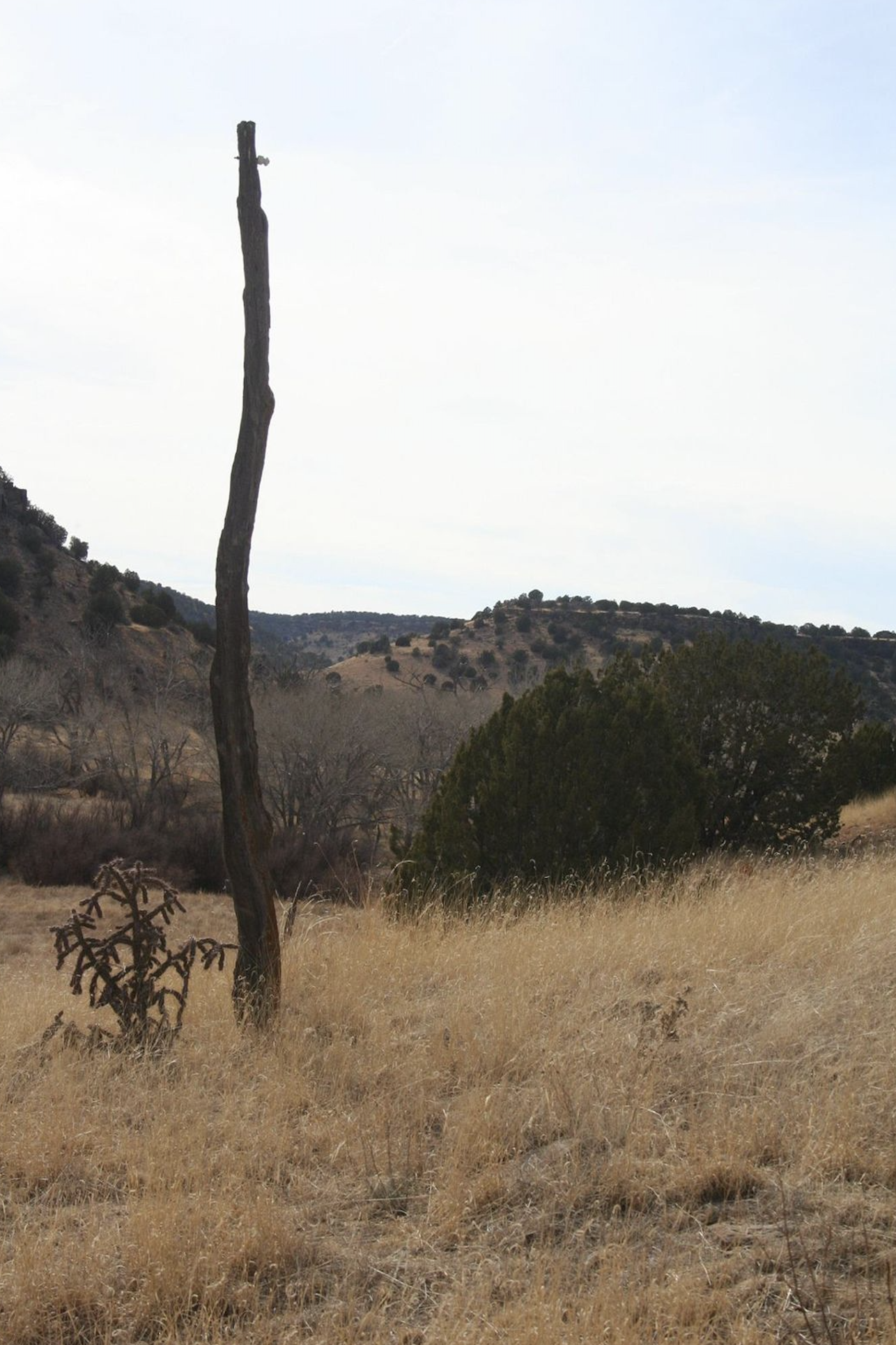
Not too many years ago, a few of those telephone poles still stood in the Carrizo country on the old Dunlap Ranch in southwest Baca County, Colorado.
Perhaps that is what I enjoy most about local history. One story often leads to another. A blog about barbed-wire fence telephones prompted me to revisit an old newspaper clipping I had nearly forgotten about one of the largest cattle companies in the American West embracing one of the newest technologies of its day.
Author’s Note: My fellow historian and co-author of “Broomcorn on the High Plains” has told me they did not get a phone until 1962 in far eastern Baca County.
References
- Lorie Emerson, “A Brief History of Barbed Wire Fence Telephone Networks,” Insulator Gazette, August 31, 2024, https://loriemerson.net/2024/08/31/a-brief-history-of-barbed-wire-fence-telephone-networks/.
- The Caldwell Advance (Caldwell, Kansas), April 20, 1882, p. 1.
- Barber County Index (Medicine Lodge, Kansas), June 8, 1883, p. 4.
- A. W. Thompson, “Old Cow-Outfits of the Cimarron,” The Cattleman (Southwest Texas Cattle Raisers’ Association), 1938, 95.
- Las Animas Leader, July 7, 1882; Anderson, “Prairie Cattle Company.”
- H. Allen Anderson, “Prairie Cattle Company,” Handbook of Texas Online.
- Barber County Index (Medicine Lodge, Kansas), June 8, 1883, p. 4.
- Robert V. Bruce, Bell: Alexander Graham Bell and the Conquest of Solitude (Boston: Little, Brown and Company, 1973), 300–315.
- Dorothy A. Zamora and Yvonne R. Oakes, Entrepreneurship and the Settlement of Des Moines, Union County, New Mexico, Archaeology Notes No. 349, principal investigator Timothy D. Maxwell (Santa Fe: Museum of New Mexico, Office of Archaeological Studies, 2004). https://nmarchaeology.org/wp-content/uploads/2024/05/349.pdf
Want to learn more about Old Boston Colorado? Find it and our other titles on Amazon:


Leave a Reply
You must be logged in to post a comment.