
This started as a post about the near completion of a book. Then, as often happens on the High Plains, life changed quickly.
The recent fires in southeast Colorado — fires that nearly took Campo itself — became a reminder of something much bigger than a book project. As flames pushed across the prairie, smoke darkened the horizon, highways closed, and entire communities stood on edge, something else rose just as powerfully: the culture of the people who call this country home.
Many things shape culture. I have reflected on that often over the years as life has taken me to most major cities across the United States and to places around the world that most Americans will never experience. You expect differences between cultures in different countries, but I have often been amazed by the diversity of culture that exists within the borders of the United States itself. One definition describes culture as “a collective programming of the mind that distinguishes the members of one group or category of people from another.”
Out here on the High Plains, culture is not something discussed nearly as much as it is lived. It reveals itself during moments of hardship and uncertainty. It is volunteer firefighters leaving their own homes and families to stand in front of a wall of flame. It is county crews running blades and hauling water through smoke and blowing dust long after exhaustion should have sent them home. It is farmers showing up with discs and tractors before anyone even asks. It is ranchers gathering cattle in the middle of chaos, offering trailers, pickups, pasture, feed, and help to neighbors who may someday return the favor — or may not. It is linemen rolling south in convoys with lights flashing while entire communities breathe a little easier just seeing them come. It is schools opening shelters, grocery stores donating supplies, and neighboring counties and neighboring states sending manpower and equipment simply because people needed help.

That is culture too.

Over the last several days, I have read countless comments from local residents reflecting pride in the firefighters, ranchers, farmers, county crews, linemen, EMS personnel, law enforcement officers, and volunteers who stepped forward during these fires. Several of those comments impacted me deeply enough that I have included the full text of them at the end of this piece for readers. Together, they capture something difficult to explain unless you have lived here: when hardship comes to the High Plains, people show up.
Brad Cook of Walsh perhaps summarized it best when he wrote, “I wouldn’t want to be anywhere else other than right here with all these amazing community members and volunteers.” Tyler Gibson of Springfield echoed that same spirit while reflecting on the fires from Denver, writing, “When things get bad, people don’t sit around waiting for someone else to fix it. They just show up and lend a hand.” Josh Wittler reminded everyone of another reality of rural life: responsibility. In a place where resources are limited and emergencies are real, selfish decisions can affect entire communities. Rural culture depends upon people understanding that individual choices carry collective consequences.
Watching these events unfold caused me to think deeply about the work Steve Doner and I have spent years trying to preserve through our broomcorn history projects. At first glance, broomcorn and wildfire may seem unrelated, but they are tied together by something deeper: the culture of persistence on the High Plains.

The near completion of Broomcorn on the High Plains arrives during days when that culture has once again been tested and once again proven strong. More than a decade ago, this project began simply because I had a few old photographs and had heard a few stories. What quickly became obvious was that an important piece of America’s agricultural history was disappearing. The people who lived it were aging. The photographs were fading. The stories were in danger of being lost forever.
That realization became the beginning of a journey.
Eventually, it also led to Steve Doner and I joining forces. The result is far greater than either one of us could have accomplished alone. Together we have tried to preserve not just the history of broomcorn, but the culture surrounding it — the labor camps, the cook shacks, the “Johnnies,” the buyers, the families, the droughts, the wind, the grit, and the stubborn determination that built an economy from a crop most modern Americans have never even heard of.
Broomcorn itself demanded toughness. The work was brutal. The harvest could not be mechanized. Men bent over rows with knives under scorching heat, cutting brush by hand while dust coated their lungs and sweat soaked their clothes. Yet generation after generation returned to the fields because that is what people here did. Adversity was not unusual. It was expected.
Perhaps that is why communities like Campo, Walsh, Springfield, Vilas, Pritchett, and Two Buttes still respond the way they do today. The culture formed by drought, wind, isolation, Dust Bowl hardship, broomcorn harvests, cattle work, and prairie survival did not disappear. It simply evolved. The people who once built ricks of broomcorn and fought dust storms are the grandparents and great-grandparents of the volunteers now fighting prairie fires.
The tools changed. The character did not.
As America approaches its 250th birthday, I hope readers understand that the story of broomcorn is not merely agricultural history. It is part of the larger American story — a story built by ordinary people doing extraordinarily difficult things without expecting recognition for it.

The fires of recent days have reminded me why preserving these histories matters. History is not just about dates and events. History is culture remembered.
And because of the dry conditions across the region, the reality is that this may not yet be over. More smoke may rise on the horizon before this season ends. More firefighters, ranchers, farmers, linemen, EMS personnel, and volunteers may again be called upon to protect these communities.
But the fires of recent days have already reminded us of something important: out here on the prairie, when hardship comes, people still show up.

And if Broomcorn on the High Plains accomplishes anything worthwhile, I hope it stands as a reflection of the same strength of community that has again revealed itself during these terrible days of fire across southeast Colorado.
That may be the most important history of all.
Selected Community Reflections During the Southeast Colorado Fires
The following comments are reproduced in full because they reflect the character, culture, and spirit of the communities of southeast Colorado during the recent fires.
Brad Cook — Walsh, Colorado
“Once again, I am in awe of the volunteers in our county. Pritchett, Campo, Springfield, Two Buttes, Vilas and Walsh….your volunteer fire personnel are top notch. You guys never get enough credit, but we’re all thankful for what you do.

In addition to the firefighters, those county workers blading and hauling water are not without mention. Your tireless efforts are also commended.
To the farmers with discs and equipment, I tip my hat. I know the firefighters love to see you all coming to help too.
The ranchers that were providing gathering assistance, pickups, trailers and moving cattle. You guys rock.
Lastly, the neighboring agencies that joined the fight also. You have left your jobs and families to assist people that you probably don’t even know. That is beyond commendable.
I wouldn’t want to be anywhere else other than right here with all these amazing community members and volunteers!
Edit!! I need to add one group! Our area linemen! I just met a convoy of SECPA trucks at Springfield, lights flashing, headed south!”
Tyler Gibson — Springfield, Colorado
“In scary times, I always go to this quote from Mr. Rogers.
I’m in Denver for a training (which feels like the worst timing), and while I was on the road, we got word that the Sharpe Fire had crossed into Colorado and evacuations were happening imminent for Campo.
Bernie immediately started calling our employees and clients to make sure people knew what was going on and were prepared if they needed to leave. We talked and decided to open the Baca Home Care office if anyone needed somewhere to go.
Chelsey came up to help Bernie. Pauline from the grocery store donated snacks and water. Amy grabbed extra supplies, donated by Family Dollar, went home and cooked food and brought it up in case anyone needed something to eat.
But that’s just one piece of what’s happening today.
I’ve seen people offering trailers, helping move livestock, opening their homes, offering land for animals, checking on neighbors. The school opening as a shelter. Other communities sending fire trucks and manpower to help.
This is what small towns and rural communities do.
When things get bad, people don’t sit around waiting for someone else to fix it. They just show up and lend a hand.
I hate that I’m stuck in Denver tonight instead of being home, but I’m incredibly proud of my team, proud of this community, and proud of every person showing up to help tonight.
Stay safe, everyone, especially our Fire, Police, and EMS crews.
Mr. Rogers said to look for the helpers. In our community, you don’t have to look very hard.”
Josh Wittler — Springfield, Colorado
“I believe the poor visibility is in motorists’ clouded judgement, decision making, and selfishness. Each road closure of Hwy 287 results in motorists of all sizes (cars, pickups, semis, etc.) trying to circumvent the road closure by going on county roads. The Vilas grade and the Walsh grade are the ones most often taken. Too many times, those motorists get lost, stuck, or have an accident.
Additionally, today they would have encountered blowing dust and smoke from the fire south of Walsh along Road 45 or had to get back to 287 in Campo — again encountering blowing dust and smoke. Then they require the deployment of our fire and EMS personnel. This takes our dedicated first responders away from being used for citizens with an immediate and legitimate emergency, or pulls them from where they might already be utilized on a larger county incident.
I’m sure that you have experienced them coming down your road doing similar things during closures, or trying to take a faster route.
I suspect the reality is this: it is best to close both highways to prevent this opportunity for poor visibility caused by clouded judgement and decision making — or just plain selfishness.”
Russ Watson – Eads, Colorado
The Sharp Fire: A Community Tested by Fire, Wind, and Fear
On a day that many in southeast Colorado will not soon forget, the Sharp Fire started in Oklahoma and pushed north into Colorado, becoming a fast-moving and dangerous wildfire that threatened the town of Campo.
As the fire moved directly toward Campo, conditions changed quickly. The threat became serious enough that a mandatory evacuation was ordered for the town. Families were forced to leave their homes, not knowing what they would return to, while placing their trust in firefighters, law enforcement, emergency management, ranchers, farmers, pilots, equipment operators, and countless others working together to protect their community.
Kiowa County Fire Protection District was requested for mutual aid as the fire continued to grow and move rapidly. Kiowa County units responded at approximately 1:15 p.m. and did not return home until around 12:30 a.m.
KCFPD responded with:
* 2 — 500-gallon brush trucks, each staffed with 2 firefighters
* 1 — 2,000-gallon water tender staffed with 2 firefighters
* 1 — command vehicle staffed with 2 firefighters
One of our command personnel and a firefighter assistant was assigned to provide division-level incident command for the fire east of Campo, where the fire threatened the cemetery and several homes east of town.
The fire conditions were intense and constantly changing. Staging locations had to be moved multiple times as the fire threatened different areas. Crews worked in heavy smoke, shifting winds, and dangerous fire behavior while trying to stay ahead of a fire that was moving across open country with speed and force.
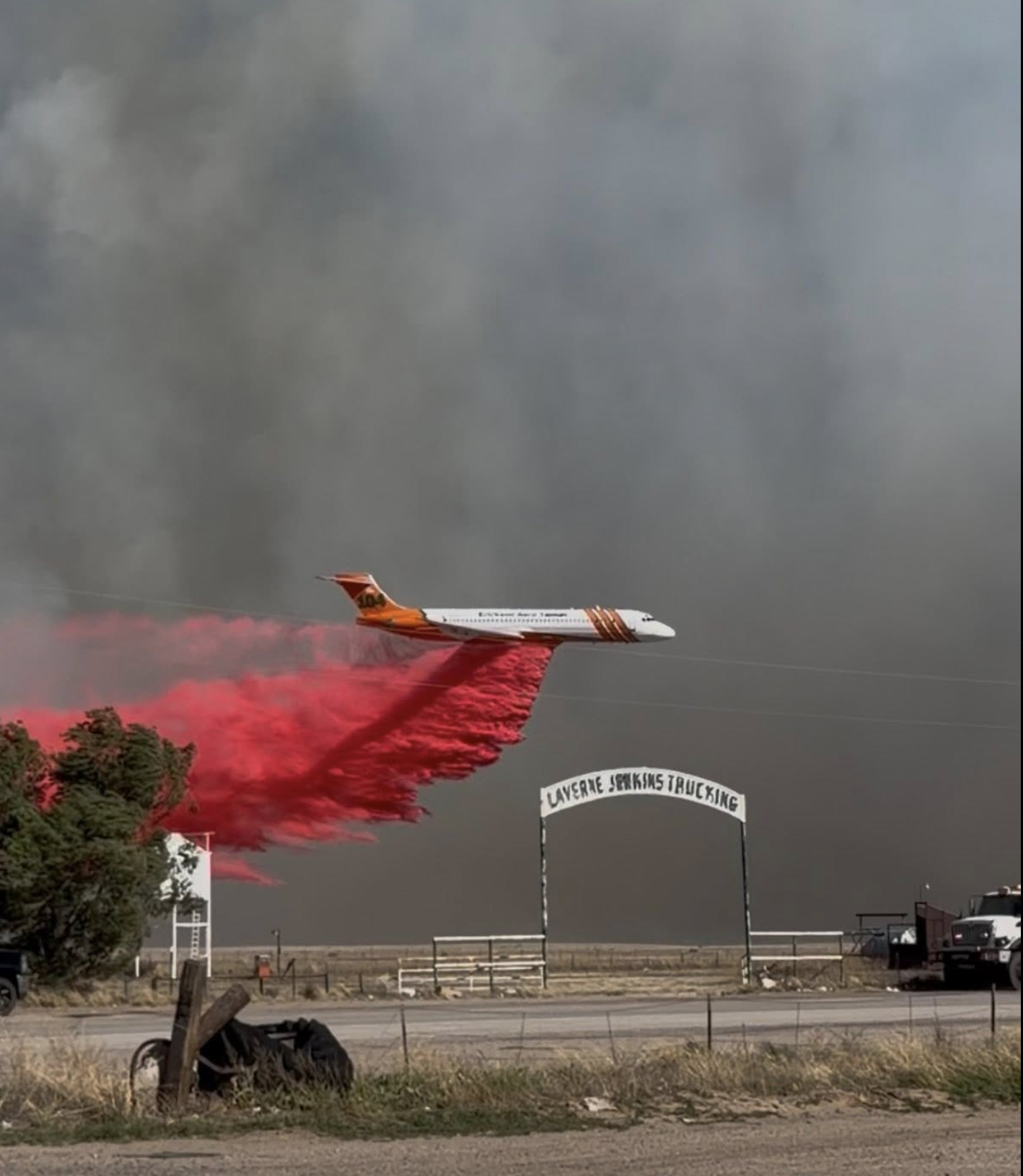
The photos show only a small part of what was happening on the ground and in the air. Air support from the National Forest Service made retardant drops while ground crews worked to build and hold fire lines. Maintainers, tractors with blades and discs, brush trucks, water tenders, nurse trailers, and countless pieces of equipment were all part of the effort. While some crews were creating fire lines and extinguishing active fire, others were assisting with backburn operations after the fire was turned over to the state. The large fireball flares seen in some of the photos were part of those backburn assignments, used to remove fuel and help stop the forward progress of the fire.
This was not just a fire department response. This was a full community and regional effort.
Support came from multiple volunteer fire agencies, incident command staff, the EOC, Emergency managers, sheriff’s offices, utility companies, ranchers, farmers, equipment operators, CDOT, and local citizens. Water tenders and nurse trailers kept water moving. Tractors with blades and discs helped cut line. Maintainers worked ground. Food and drinks showed up for responders — pizza, hamburgers, snack bars, beef sticks, boxes of fruit, water, Gatorade, and more.
Even when equipment issues came up, people stepped in. One of our trucks developed a cracked radiator reservoir, and an individual from Springfield opened up his parts store and helped get the needed part delivered so the truck could stay in the fight. That kind of support may seem small to some, but on a fire like this, those moments matter.
The town of Campo may be small, but the people there are fierce, resilient, and strong. They left their homes with uncertainty in their hearts, but also with trust and hope that first responders and everyone involved would do everything possible to protect their little piece of comfort they call home.
To the families who evacuated, thank you for your cooperation and patience during an incredibly stressful situation. To the firefighters, law enforcement officers, CDOT, dispatchers, pilots, equipment operators, ranchers, farmers, utility crews, mechanics, food providers, water haulers, command staff, EOC personnel, and everyone else who helped — thank you.
To the local communities who offered prayers, supplies, encouragement, and support — thank you. Those prayers and that support were felt.
Wildfires like this remind us how quickly things can change, how dangerous our conditions can become, and how much we rely on one another when it matters most. No single agency, truck, aircraft, tractor, or crew stops a fire like this alone. It takes everyone.
Our thoughts remain with the landowners, residents, firefighters, and all those affected by the Sharp Fire. We are grateful for the safe return of evacuated families, thankful for the work done by so many, and proud to stand beside our neighboring communities when they call for help.
If anyone would like to tag or comment an individual or agency that has assisted on this fire, please feel free to do so. There were so many, I couldn’t have even come close to getting them all.
Special thanks to Russ Watson, District Chief at Kiowa County Fire Protection District, Clara Tanner along with Rafe Schroder and Tyson Chick, for providing several of the powerful photographs documenting the recent fires across southeast Colorado. Their images captured not only the intensity of the fires themselves, but also the courage, sacrifice, and resilience of the people and communities who faced them.
History is culture remembered. It is why we do what we do.


Leave a Reply
You must be logged in to post a comment.