
Back in 2007, our little town of Springfield, Colorado, found itself right in the thick of a contest that seemed tailor-made for folks with a good sense of humor.
For nearly two decades, folks everywhere had been watching The Simpsons on television, scratching their heads and trying to figure out just where in the world Homer Simpson’s hometown was supposed to be. Everybody knew Springfield was somewhere in America, but pinning down the exact state was all part of the joke. The folks who made the show would throw out a clue here, contradict it there, and leave dozens of real-life Springfields across the country free to claim Homer, Marge, Bart, Lisa, and little Maggie as their very own.
When The Simpsons Movie was getting ready to hit the big screen in 2007, that running joke spilled right over into the real world. Fourteen different Springfields got an invitation to put together a little video explaining why their hometown deserved to host the movie’s official premiere. Our own Springfield, Colorado, didn’t hesitate for a second—we jumped right into the contest.
We weren’t the biggest Springfield in the running by a long shot, and when all the votes were counted, Springfield, Vermont, took home the win. But there was something mighty familiar about the whole affair. You see, Springfield, Colorado, had been introduced to the rest of the country as just one member of America’s big family of Springfields long before that. Seventy-two years earlier, to be exact.
On October 20, 1935, folks reading The Springfield Sunday Union and Republican over in Springfield, Massachusetts, opened up their Sunday paper to find a big spread asking a simple question:
“Do You Know Your Springfields?”

The subtitle went on to explain that the Massachusetts city was sitting at the head of “a family of twenty-eight.”

The whole idea back then was remarkably like the fun we had with The Simpsons contest all those years later. There were Springfields scattered all across the nation, so folks naturally wondered: what made each one special? That Massachusetts paper took its readers on a grand little tour of them all (NOTE: Full transcription is provided at the end of this post).
They talked about Springfield, Illinois, with a population of 65,000, famous for Abraham Lincoln’s tomb and the state capitol building. Springfield, Ohio, had 70,000 people and made its mark as a manufacturing and publishing hub. Springfield, Missouri, counted 55,000 residents and boasted colleges, railroad shops, factories, and mines. Even Springfield, Vermont—the very town that would win The Simpsons contest in 2007— was listed back then with about 7,000 people. And then, of course, they got around to little ol’ Springfield, Colorado — Population 1,400. Sitting a good sixty miles from the nearest railroad. And planted right smack dab in the middle of the Dust Bowl.
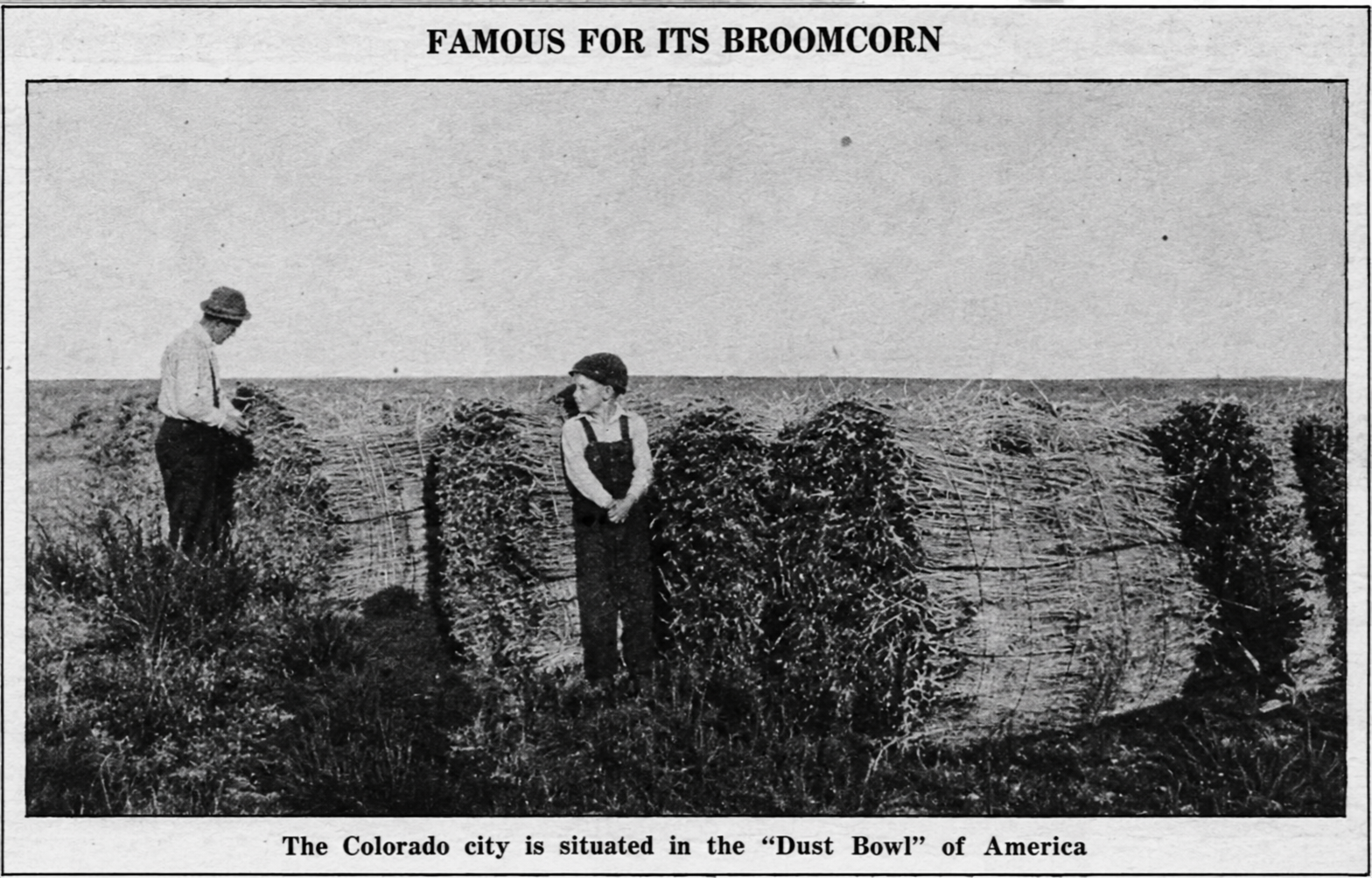
Now, that might not sound like much of a boast on the surface, but our little Springfield also had something none of those other towns possessed. Broomcorn.
That Massachusetts newspaper proudly introduced our town as the county seat of Baca County, “the largest broomcorn producing county in the world.” A photograph right alongside the article put it as plain as day:

There wasn’t any point in sugarcoating where Springfield was or what our folks were dealing with back then. The other photo caption stated clearly that we were a Colorado city situated right in the “Dust Bowl” of America.
That’s what makes the whole thing so remarkable, when you remember this was October 1935.

By that time, nobody around Baca County needed a newspaper article to remind them they were living through a terrible drought. The previous two years had been some of the grimmest of the entire Dust Bowl. Crops had failed completely, the fierce prairie winds had carried off untold tons of good southeastern Colorado soil, and some heartbroken families had already packed up and moved away.
And yet, nearly 2,000 miles away, when folks in Massachusetts tried to explain to their readers what set Springfield, Colorado, apart from every other Springfield in the land, the answer was still broomcorn.
The fellow who helped tell Springfield’s story to the rest of the country was someone who knew a thing or two about standing up for Baca County.
S. M. Konkel, former editor of the Democrat-Herald, provided the Massachusetts paper with a description of his home town. “Springfield, Colo., was named by settlers from Springfield, Mo.,” Konkel wrote. “It is a typical Colorado town situated on the plains and what is known as the dust bowl of America.”
Konkel didn’t hide the facts about the drought, but he sure wasn’t about to let folks back East think that Springfield was just drying up and blowing away into nothingness.
He made sure to point out that our town sat right along U.S. Highway 59 between Amarillo and Denver. He let them know Springfield had good hotels, fine schools, natural gas, electricity, and paved streets. Even after enduring three long years of severe drought, Konkel reported with pride that both the town and its local school districts were running straight on a cash basis.
And he was able to share a little bit of good news, too.
A few rain showers over the previous three months had helped settle much of the blowing dust, Konkel noted, and things were looking up for planting a good crop of wheat that fall.
Reading it today, you can hear Konkel speaking to the rest of America: Yes, you’ve heard all about the Dust Bowl. We’re right in the middle of it. And we’re still standing.

There are several interesting aspects of the article is its reference to our pioneer newspaperman, S. M. Konkel, who apparently provided information about Springfield, Colorado, for your paper’s 1935 article. Konkel published our paper 1913-1930. 1) Sam had not owned the paper since 1930, 2) Two of the three photos used in the article were from Springfield and were likely part of our archives. 3)He had passed away on August 4, 1935, more than two months before your newspaper published the article so he never saw it in print. Here is Sam’s death notice from our 1935 archives. The photos I am interested in below were likely in our archives before they were sent to and used in your 1935 article.
That 1935 article went ahead and ranked all 28 Springfields by their population. Massachusetts came out on top with 150,000 people. Ohio followed with 70,000, Illinois with 65,000, and Missouri with 55,000. Our own Springfield, Colorado, landed right at No. 13. Now, comparing a town of 1,400 to big cities wasn’t exactly a fair fight. But every Springfield had its own special claim to fame. Illinois had Abraham Lincoln. Tennessee had its tobacco. Oregon had timber. New Jersey bragged that it was just 45 minutes from Broadway.
And Baca County had broomcorn.
Back in 1935, that was no small thing to brag about.
Broomcorn brought buyers, hard-working harvest crews, and good money into southeastern Colorado. When the railroad finally reached Baca County back in 1926, it gave local growers a much better way to ship their crops off to distant markets. Train car after train car loaded with broomcorn rolled out of the county. Springfield, Walsh, Vilas, and all the surrounding country became deeply tied to a crop that most of America has nearly forgotten today.
Even the hardships of the Dust Bowl couldn’t erase that proud reputation.
Then, 72 years later, somebody decided it was time for America’s Springfields to square off once again.
Only this time, the prize wasn’t just a write-up in a Sunday newspaper out of Massachusetts. It was hosting the premiere of The Simpsons Movie.
And sure enough, Springfield, Colorado, was right back in the middle of the action.
Our town put together a video, joining 13 other Springfields in trying to convince the country that Homer Simpson belonged with us. Vermont took top honors in the end, narrowly beating out Springfield, Illinois. Now, neither contest ever truly settled which Springfield was the absolute best, but that was never really the point anyway.
What those stories do show us is something special about our town.
Whenever we’ve been given the chance to stand tall next to all those bigger places sharing our name, Springfield, Colorado, has never been bothered by the odds stacked against us. In 2007, we made our stand with Homer Simpson.
Way back in 1935, Sam Konkel made our case with paved streets, natural gas, a town that kept paying its bills through three hard years of drought—and a crop that helped put Baca County on the map.
We were the Springfield in the Dust Bowl.
We were the Springfield with the broomcorn.
And you can bet that whenever someone gets around to calling up the Springfields of America, we’re going to be right there showing up.
Here is the original article: The Springfield Sunday Union and Republican (Springfield, Massachusetts), October 20, 1935, p. 51, “Do You Know Your Springfields?—This City Heads a Family of Twenty-eight.” Photograph captioned “Famous for Its Broomcorn.” Images and content courtesy of The Springfield Republican, MassLive
Do You Know Your Springfields? — This City Heads a Family of Twenty-eight
The “Big Four” Dot the Maps of Massachusetts, Ohio, Illinois and Missouri—The Other Two Dozen Are Scattered from Georgia to the Canadian Border And from Maine to Washington—Some Have Only A Postoffice—Smallest Listed Population is 81 in Maryland Community and Three Have None at All Recorded
By KEN KIMBEL

MR. AND MRS. Massachusetts Springfield, I want you to meet the family; you know Ohio, Illinois and Missouri Springfields but did you know that there are still two dozen others scattered over these United States from Maine to Georgia and out to Oregon?
Maybe you have never heard of them—these two dozen baby Springfields, but the clerks in the local postoffice know all about them. Seldom does a day pass that mail is not rubber stamped “Missent to Springfield, Mass.,” and put back on the train to travel for which it was intended.
And, although you are just now getting acquainted with your 27 “cousins,” they have the advantage for they all know “Papa” Springfield, the biggest of all, in Massachusetts and read with interest news accounts from this city.
Finding Still Another
There is not a Springfield from coast-to-coast that does not have a druggist or news-dealer selling postcards who’ll tell you of the traveler, buying local view cards and saying—with a touch of superiority in his voice, “I am from Springfield, Mass., and I wish to send these home to show the folk that I have discovered still another Springfield.”
When these folks from Springfield, Maine, or Georgia, or Idaho, visit this city and walk up and down Main street, they stare at the tall buildings and exclaim: “So this is Springfield! Doesn’t look like a thing back home.”
Here is a brief sketch of each of the other Springfields, arranged in alphabetical order according to states:
Springfield, Arkansas
Springfield, in Arkansas, has a population of only 319 and is in Conway county, near Jerusalem, but 10 miles from a railroad. This Springfield is between two creeks, Cypress and Cadron, and 40 miles north of Little Rock the state capital.
Colorado—Broomcorn Center
Springfield, Col. population 1400, is 60 miles from a railroad and is the county seat of Baca, the largest broomcorn producing county in the world. Here they raise livestock, have oil wells, and two weekly papers, the Democrat-Herald and the Baca County Republican. S. M. Konkel, editor of the Democrat-Herald, writes: “Springfield, Colo., was named by settlers from Springfield, Mo. It is a typical Colorado town situated on the plains and what is known as the dust bowl of America.
“Located on U. S. Highway 59, Amarillo to Denver. We have all modern facilities, good hotels and schools, natural gas, electricity, and paved streets. Despite severe drought the past three years, the town of Springfield and the local school districts are both on a cash basis. Showers the past three months have stopped much of the dust blowing and prospects are that much wheat will be planted this fall.”
Georgia—Sawmill and Cannery
Springfield, Ga., population 377, Effingham county, is the county seat, and is on the Savannah and Atlanta railroad, 25 miles from Savannah and the coast. Here they have a saw mill and a cannery. This section’s chief products are cotton, potatoes, corn, syrup, and tobacco. The weekly paper is the Herald.
Idaho—On the Snake River
Springfield, Ida., population 295, Bingham county, is on the Snake river and the Union Pacific railroad. It is not far from Montana, Wyoming and Utah, “way out there in the wild and wooly West.”
Illinois—Big Railroad Shops
Springfield, Ill., is the state capital. It is a city of 65,000 in Sangamon county, 185 miles southwest of Chicago. It is served by six railroads. This Springfield has railroad shops in a big way, and also manufactures shoes, agricultural implements, tractors, road graders, boilers, foundry and machine shop products, garage equipment, radiators, watches—Illinois Watch company, with 1400 employes.
It is here that Abraham Lincoln is buried and his grave is marked by an imposing national monument. Large quantities of bituminous coal are shipped from this Springfield. The city boasts of Concordia seminary (Evangelical Lutheran); Ursuline academy, (Catholic); Academy of the Sacred Heart, (Catholic), many state buildings; the state fair grounds, state rifle range and militia camp grounds.
Kentucky’s Springfield
Springfield, Ky., population 1529, is the county seat of Washington county and is located just 28 miles from Hodgenville, Lincoln’s birthplace, where another national monument stands. Kentucky’s Springfield is 35 miles southeast of Louisville, home of the famous Kentucky derby. It is on the L. & N. railroad, is a big tobacco market and its weekly paper is the Sun.
Louisiana—45 Miles from New Orleans
Springfield, La., population 300, Livingston county, is eight miles from a railroad and eight miles from the county seat, Springville, and 45 miles northwest of New Orleans.
Maryland—Population 81
Springfield, Md., population 81, Prince George county, is just out of Washington, D. C., on the Pennsylvania railroad near Bowie, Md. E. E. Perkins of Springfield, Md., writes:
“All the farms in this section have names. The farm of which the village of Springfield was originally a part is known as Springfield and the village is so called. When the Pennsylvania railroad was built through here in the ’70’s they located a station here and called it Springfield Station.”
Maryland’s Springfield has no postoffice.
Maine—Way up North
Springfield, Me., population 497, Penobscot county, is “way up in Maine, and 12 miles from the nearest railroad. Nearby is a little town named South Springfield.
In Minnesota
Springfield, Minn., population 1849, Brown county, is on the C. & N. W. railroad, 100 miles southwest of Minneapolis and in the same county with Sleepy Eye, Minn. This Springfield has a brick, tile and silo plant, makes hardware store fixtures, has a cabinet shop and a flour mill. Its weekly paper is called the Advance-Press.
Missouri—Big City
Springfield, Mo., in Greene county, is a big city of 55,000, 200 miles southeast of Kansas City, and 225 miles southwest of St. Louis, and is served by three railroads. Here they have railroad machine shops, iron works, packing plant, creameries, flour mills, lime, clothing, furniture, wagon and overalls factories.
Springfield, Mo., boasts of Drury college, 360 students; State Teachers’ college, 2300 students; and the Central Bible institute. They also have timber, stone quarries and lead and zinc mines.
Springfield, Mo., is the gateway to the many popular White River resorts and has two daily papers.
Nebraska—Near Canadian Border
Springfield, Nebr., population 413, Sarpy county, is on the Missouri Pacific railroad, just 20 miles southwest of Omaha. Here they have stock feeding yards, ship plenty grain and have a weekly paper named the Monitor.
New Hampshire—East and West, Too
Springfield, N. H., population 349, is in Sullivan county, 35 miles northwest of Concord, the state capital. New Hampshire also has an East Springfield and a West Springfield nearby.

New Jersey—45 Minutes from Broadway
Springfield, N. J., population 5090, Union county, is 45 minutes from Broadway on the electrified D. L. & W. railroad. Donald B. Palmer, of this place writes: “It has always been generally accepted that the name of the town was derived from the fact that its surrounding fields were literally full of springs. In fact, some of them still exist and part of the water supply for this portion of the county is obtained from artesian wells located here.”
This Springfield is rich in historic lore and several years ago held the sesquicentennial celebration of the battle of Springfield, N. J.
New York—38 Miles from Utica
Springfield, N. Y., population 109, Otsego county, is near Springfield Center which has a postoffice and another nearby town is named East Springfield. All are about 30 miles southeast of Utica.
North Carolina—A Little Place
Springfield, N. C., is a little postoffice in Wilkes county, near the famous Blowing rock, Roaring river and Grandfather mountain. No population is listed for this Springfield and it has no railroad connection.
Ohio—One of the “Big Four”
Springfield, Ohio, is another of the “Big Four”—in Mass., Ill., Mo., and Ohio. Ohio’s Springfield has a population of 70,000, and is in Clark county, 4 miles from Dayton, and is served by three railroads. It is a publishing center—where your American, Woman’s Home Companion and Farm and Fireside comes from. It also has two daily papers.
Here they manufacture agricultural implements, gas and steam engines, machinery, tools, water wheels, coffins, steam rollers, piano plates, motor trucks, incubators, electric fans, motors and paper-hanger’s supplies. They also have flour and feed mills and the Wittenberg (Lutheran) college. The city is noted for its roses.
Oregon—60 Miles From the Coast
Springfield, Ore., population 1855, Lane county, is on the Southern Pacific railroad, 60 miles from the coast. Here they have a lumber mill and potatoes and hogs in large quantities. Their weekly paper is called the News.
Pennsylvania—Two of Them
Springfield, Pa., population 2500, Delaware county, is 10 miles west of Philadelphia and a residential suburb of the big city. It has a weekly paper called the Springfield Township Citizen.
The Keystone state has another Springfield in the opposite corner of the state. Springfield in Erie county, is on the New York Central railroad, three miles from Lake Erie and two miles from a little town named North Springfield.
South Carolina—Colorful History
Springfield, S. C., population 4500, (including two mill villages just over the corporate limits) is in Orangeburg county on the Southern railway and was named after Springs Old Field.
James H. Fanning, attorney for the Southern Railway company writes:
“No one can give a brief history of this Springfield, its founding, history before and during the Revolutionary war, its mills, vast bodies of yellow pine; the struggle with poverty in clearing its fertile fields, the founding of schools and churches, Catholic, Methodist, Baptist and Lutheran.
“The war between the North and South; the reconstruction period when the Klu Klux stood for white supremacy and in this section was backed by all Catholics and the few Jews that lived here.
“We have a large electric water power light plant, a new $60,000 school building and we did have two very strong banks before the Hoover deflation and now have a very modest one—only one.
“Irish predominate: Republicans are as scarce in Springfield, S. C., as saints are in hell. We are for Roosevelt and against the fulminations of Talmadge,” concludes the versatile Mr. Fanning.
South Dakota—On the Missouri River
Springfield, S. D., population 689, Bon Homme county, is on the great Missouri river, and the C. M. & St. P. railroad, 89 miles northwest of Sioux City, Iowa. The Southern State Normal school is located here and the town has a weekly paper called the Times.
Tennessee—Named for a Spring
Springfield, Tenn., population 6000, Robertson county, is on the L. & N. 30 miles northwest of Nashville. Here they have a woolen, grist and saw mill, and ship much grain, tobacco and live stock. They have two weekly papers, the Herald and Robertson County News, and the Robertson County Times.
A. L. Dorsey, attorney, writes: “Springfield, Tenn., was made for a spring in the field here and is a big dark fired tobacco market. Nearby is the county where Joseph W. Byrne, speaker of the House, and Jesse H. Jones, chairman, RFC were born and reared.”
Vermont—Our First Namesake
Springfield, Vt., population 7000, Windsor county, is on the Black river, near the Connecticut; five miles from the nearest railroad and 40 miles from the Massachusetts state line. Here they have machine shops, worked wool mill, and a weekly paper called the Reporter.
P. C. Kittredge, secretary, Springfield (Vt.) Chamber of Commerce, writes: “The town of Springfield, Vt., was chartered by Benning Wentworth, royal governor of New Hampshire, August 20, 1761, to 62 proprietors living in Northampton, Mass., only one of whom ever came to the town to live. Among the very early settlers were three brothers by the name of Spencer and tradition says that they brought the name of the town from Springfield, Mass., the first name-sake for that city.”
Virginia—Near Washington
Springfield, Va., is just out of Washington, D. C., on the west. Like Springfield, Md., it guards the capital city on the east. Virginia’s Springfield is on the Southern railway. It is just a little postoffice and has no population listed for it.
Washington—Changed to Wauna
Springfield, Wash., has had its name changed in recent years to the more exclusive character of “Wauna,” and is in the Big Harbor Peninsula district there by Puget Sound.
West Virginia’s Springfield
Springfield, W. Va., population 167, Hampshire county, is on the B. & O. railroad a few miles from the Maryland and Pennsylvania state line.
In Wisconsin
Springfield, Wis., population 309, Walworth county, is on the C. M. St. P. & P. railroad, about 40 miles southwest of Milwaukee.
So now, Mr. and Mrs. Massachusetts Springfield, you have been introduced to all of the Springfields and to your new and greetings and say, “Come out to see us sometime!”

Want to learn more about Old Boston Colorado? Find it and our other titles on Amazon:


Leave a Reply
You must be logged in to post a comment.