If you’ve ever dug into the weirder corners of minor league baseball history, you know team nicknames can get pretty wild. But even by Class D standards, east-central Illinois in the early 1900s was playing in a league of its own.
For two brief summers, local ballclubs took the field named not after fierce animals or soaring birds of prey, but after seasonal migrant harvest hands armed with broomcorn knives.
The story of how professional ballplayers ended up taking the field as “Canaries” and “Broom Corn Cutters” actually began as a historical detective story—one that stretched from the high plains of Colorado all the way back to the post-Civil War Midwest.
The Mystery of the name “Broomcorn Johnnies”
A few years ago, Dick Bishop from Springfield, Colorado—whose dad, Ray, was once crowned the Broomcorn King as one of the biggest broomcorn growers out in the Baca County, Colorado broomcorn district—raised a simple question: Where on earth did the nickname “Broomcorn Johnnies” actually come from?

Growing up in western farm country, everyone knew the name. Every harvest, waves of traveling workers would roll into town to cut brush, and folks just called them “Johnnies.” But nobody quite remembered who coined it or why.
Digging into old interviews, regional archives, and documentary footage, my co author of “Broomcorn on the High Plains,” Steve Doner and I started piecing the puzzle together.
The trail led back to east-central Illinois in the 1860s. After the Civil War, the South’s economy was in ruins, leaving thousands of Confederate veterans desperately looking for paying day labor. Up in Illinois, an agricultural boom was taking off around a specialized crop: broomcorn.
The theory goes that these veteran laborers—the old “Johnnie Rebs” from Kentucky and Tennessee—headed north in droves to harvest the broomcorn brush. The southerners embraced the “Johnnie” tag to set themselves apart from northern hands, local farmers picked it up, and the name stuck. Essentially, “Broomcorn” + “Johnnie Rebs” = “Broomcorn Johnny”
By the late 1890s, the nickname was showing up in local newspapers. In 1897, the Decatur Daily Review casually mentioned that the “broom corn Johnnies have about all disappeared” for the winter. A few years later, the same paper declared the nearby town of Arcola the undisputed “Mecca of broom corn ‘Johnnies.’”
Clearing Up the Geography: The Capital vs. The Belt
Now, if you want to start a friendly argument in any of the broomcorn districts across the country, just ask who owns the title of Broomcorn Capital of the World.

In Illinois, give credit where it’s due: that title belongs to Arcola, tucked into Douglas County. Around 1865, a local named Col. Cofer planted a 20-acre trial plot, and within decades, roughly half the broomcorn grown in the entire country came from that immediate area. Arcola never let go of that legacy either—they’re still home to the Monahan Partners, Libman and still throw a huge annual Broomcorn Festival.
Just a short trip south, Coles County—home to Mattoon and Charleston—sat right on the buckle of that broomcorn belt. It might not have held the official “Capital” crown, but when harvest hit each August, you probably wouldn’t know the difference. The area was bursting with brush, and hundreds of migrant hands flooded the rail depots looking for work.
In the local papers, though, the workers weren’t just called “Johnnies.” They earned far more poetic tags: “Hoosier Canaries” and “Kentucky Mocking Birds.” As one nostalgic editorial in the September 16, 1913 Mount Carmel (Illinois) Daily Republican put it, the cutters arrived in town
“…as unannounced as that of the birds and they just sort of oozed into town about the time they were needed.”
In Charleston, you couldn’t walk down the street in August without bumping into them. Hundreds of workers would set up camp on the courthouse lawn and along bank corners. Local farmers would drive their big wagons right into the center of town, haggle a bit, load up a crew, and haul them off to the farmsteads with promises of food and a bunk.
After sweating through six grueling days of cutting brush, Saturday nights belonged to the town. Between 300 and 400 hands would crowd into Charleston to blow off steam, feast on street-corner spreads of bologna, crackers, cheese, and watermelons, and spend their hard-earned cash in the saloons.
Naturally, things got rowdy. Between weekend card sharps fleecing the field hands, occasional check forgeries, and drunken brawls landing folks in police court, it was a raucous few weeks. By the time harvest wrapped, some thrifty workers hopped trains home with a full season’s wages—while plenty of others caught the next outward-bound boxcar without a dime in their pockets.
Taking the Field: Canaries, Cutters, and a “Wooden Head”
When professional baseball arrived in Coles County in 1906, the local street culture jumped right onto the diamond.


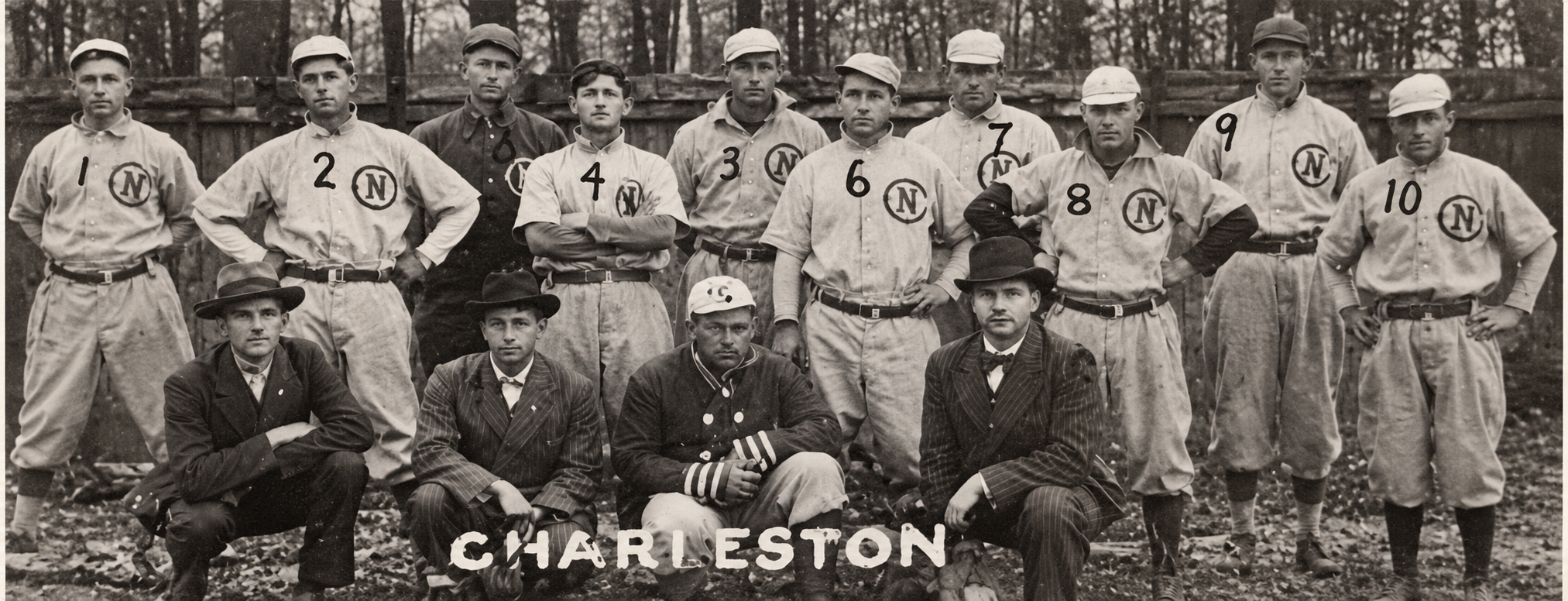
Note: This is a digitally enhanced image. The caption is cut off after “Tal,” and the names numbered 4–7 are not visible.
The Mattoon City Railway Company built an amusement park and ballpark—Urban Park Field—conveniently situated between Mattoon and Charleston along their trolley line to drum up riders. When the two rival towns agreed to field a joint team in the Class D Kitty League, fans picked a name that playfully tipped a cap to those seasonal field hands: the Mattoon–Charleston Canaries.
Sharing a team proved awkward, and after a cellar-dwelling season, the towns split. Charleston kept Urban Park Field and joined the Eastern Illinois League for 1907. This time, they leaned into the local harvest even harder, christening the club the Charleston Broom Corn Cutters.
The Cutters were actually quite good, finishing second at 71–49. But the game everyone remembered was an afternoon of pure comedy.
On May 22, 1907, Charleston pitchers Tug Wilson and Dougal McDonald did something almost unthinkable: they pitched a combined no-hitter against the Taylorville Tailors—and lost 1–0.
In the 3rd inning, a Taylorville runner named Grogan walked and was bunted over to third. The next batter hit a routine ground ball to Charleston’s third baseman. He bobbled it, panicked, and fired a throw toward home plate to nail Grogan.
Instead of hitting the catcher’s glove, the ball drilled Grogan squarely in the back of the head.
The ball caromed violently off his skull and flew clean into the grandstand bleachers. Grogan dusted himself off and casually trotted home for the only run of the ballgame. The local press roasted Charleston’s defense as a collection of “P. T. Barnum plays,” while the Taylorville paper joked the next day that when the ball was finally tossed back to the pitcher, it was “covered with splinters from Grogan’s wooden head.”
The fun didn’t last long. By 1908, famed evangelist and former big-leaguer Billy Sunday stormed through the region on a crusade against alcohol. Most of the league’s towns voted dry, drying up the saloon sponsorships that kept the clubs afloat. Charleston renamed the team the Charleston Evangelists in a bid for survival, but Sunday promptly launched another campaign banning Sunday baseball. Without ticket sales from their biggest gate days, the club folded mid-season, and professional minor league baseball left Charleston for good.

The Name Moves West—and Welcomes the “Sallies”
The ballclubs folded, and before long, the Illinois broomcorn fields began to fade too.
Soil depletion and changing farming economics pushed commercial broomcorn production out of the Midwest. The industry moved down into Oklahoma, where towns like Lindsay reigned supreme from 1915 to 1946.
As the crop took root in the Sooner State, the culture adapted to the times. During the height of World War II, with young men drafted and fighting overseas, rural communities faced severe farm labor shortages. Just as “Rosie the Riveter” stepped onto assembly lines, rural women stepped straight into the broomcorn harvest.
On August 14, 1942, the Chickasha Daily Express ran a report headlined “Women Working In Broomcorn” on a farm near Alex, Oklahoma—just up the road from Lindsay. One baling crew consisted of nine women and only a handful of men. Operating the mechanical balers in suffocating clouds of irritating brush dust, the women were praised for “making as good hands as men.”
Naturally, the local lexicon adjusted: the women stepping up to save the harvest were christened “broomcorn Sallies”—a spontaneous tribute born directly out of the universally recognized “broomcorn Johnnies” moniker.
The Name Moves West
The ballclubs folded, and although the broom manufacturing center remains in Arcola to this day, , the Illinois broomcorn fields began to fade too.
Cheaper land and labor in the west pushed commercial broomcorn farming out of the Midwest. The industry moved down into Oklahoma for a few decades, before staging its grand finale out on the high plains of Baca County, Colorado.
During the 1940s, ’50s and 60s, southeastern Colorado became the undisputed new Broomcorn Capital of the World, with local growers planting up to 75,000 acres in a single year.

What’s remarkable is that the culture moved right along with the crop. A few farm families from central Illinois packed up and homesteaded in Colorado. Companies like Arcola’s Thomas Monahan expanded operations into towns like Walsh, Colorado.
And right alongside the equipment and farming traditions, the old post-Civil War slang rode the rails westward. Decades after Illinois ballplayers took the field as “Canaries” and “Broom Corn Cutters,” the transient crews cutting brush under the blistering Colorado sun were still known by the exact same name born in Arcola’s rail yards: Broomcorn Johnnies.
The scene on Saturday night hadn’t changed a bit, either. As broomcorn buyer John Morrison later recalled in the August 6, 1987 Plainsman Herald:

“I remember the sidewalks of Springfield being so congested with broomcorn johnnies on Saturday night during the ’40s and ’50s that you had to walk out in the street. The local merchants looked forward to broomcorn harvest as it was their busiest season.”
From the courthouse lawn in Charleston to Main Street in Springfield, Colorado, the harvest had traveled a thousand miles. But for anyone who walked those crowded sidewalks on a Saturday night—or cheered on a team called the Cutters—the spirit of the broomcorn harvest remained unmistakable

Want to learn more about Old Boston Colorado? Find it and our other titles on Amazon:


Leave a Reply
You must be logged in to post a comment.