
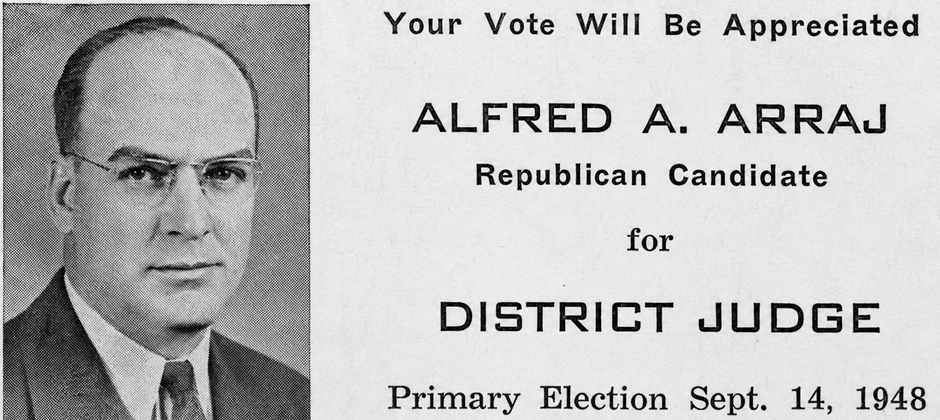

Few men embodied the spirit of southeastern Colorado more fully than Alfred A. Arraj. Born far from the windswept plains of Baca County yet forever shaped by them, Arraj rose from small-town lawyer and civic booster in Springfield, Colorado, to become one of the most respected federal judges in the American West. Today, his name is etched permanently into Colorado’s legal and architectural landscape through the Alfred A. Arraj United States Courthouse in downtown Denver, but his story begins in the quiet resilience of rural southeast Colorado.
As the modern courthouse bearing his name stands at the corner of 19th and Champa Street, it reflects not only judicial dignity and innovation, but also the values Arraj carried throughout his life: integrity, humility, service, and devotion to community.
Early Life and Ambition
Alfred A. Arraj was born on September 1, 1906, in Kansas City, Missouri, but his formative years unfolded in Colorado. According to the United States District Court for the District of Colorado, young Alfred dreamed of becoming both a prosperous farmer and the owner of a Buick automobile. Like many boys of his era, he worked odd jobs as a teenager, including picking berries and working behind a soda fountain. In characteristic Arraj fashion, both jobs ended humorously because he consumed too much of the merchandise.

Entrepreneurship arrived early. Alongside his brother Joe and cousin George Michael, Alfred helped operate a bicycle repair shop. Although he lacked mechanical talent, he excelled at bookkeeping and attracting customers—skills that foreshadowed his future success in law and public life.
Academically gifted, Arraj skipped a grade in school and eventually attended Swink High School with his brother Joe. Together, the two brothers made up half of their graduating class.
Arraj graduated from the University of Colorado Law School in 1928 and was admitted to the Colorado Bar the same year. Soon afterward, he began building a legal career that alternated between Denver and Springfield before ultimately establishing deep roots in Baca County.
Building a Life in Springfield
By 1929, Springfield had become home. Arraj quickly earned a reputation as a capable attorney and committed citizen. His law practice placed him at the center of civic and economic issues during one of the most difficult periods in the county’s history.
The Great Depression and Dust Bowl years tested southeastern Colorado with drought, economic collapse, and uncertainty. Yet Arraj remained deeply engaged in community affairs. In 1930, he represented Springfield before the Interstate Commerce Commission in support of a proposed north-south railroad line, an ambitious project viewed by many residents as vital to the region’s economic survival.

He also worked closely with local business leaders and agricultural figures, including prominent broomcorn buyer John Morrison, navigating the legal complexities of an agricultural economy struggling through historic hardship.
Arraj’s personal life flourished in Springfield as well. In December 1929, Democrat-Herald publisher Sam Konkel announced the young attorney’s marriage in the colorful and humorous style for which the newspaperman was known:
“Att’y Arraj, of the law firm of Reynolds and Arraj, went to Denver last week and converted himself into a benedict, bringing his bride right along down with him.”
The lighthearted notice reflected both the charm of small-town journalism and the affection the community already held for the rising young lawyer.
Community Spirit and Colorado Pride

Arraj never lost his connection to ordinary people or community traditions. During the late 1930s, he joined a group of thirty-four Baca County residents on a memorable trip to the 1938 Cotton Bowl in Dallas, Texas, where the University of Colorado faced Rice University.
The delegation traveled first to Amarillo before boarding a train to Dallas, turning the trip into a social event that highlighted the pride and camaraderie of southeastern Colorado. Though Colorado ultimately lost the game 28–14, the experience represented something larger: a rural community maintaining optimism, fellowship, and enthusiasm despite the hardships of the era.
For Arraj, the excursion revealed another dimension of his character. Long before he achieved prominence on the federal bench, he was already known as someone who genuinely enjoyed the people and culture of his region.
Military Service During World War II
When World War II erupted, Arraj answered the call to service. He served four years in the United States Army and attained the rank of major.
Like many members of his generation, military service broadened his perspective while strengthening his commitment to public duty. After the war ended, he returned once again to Springfield and resumed his law practice, continuing the work of rebuilding community life during the postwar years.
His reputation for fairness, intelligence, and steady judgment steadily grew across southeastern Colorado.

District Judge and Rising Judicial Influence
In 1949, voters elected Alfred Arraj as District Judge for Colorado’s 15th Judicial District. The position placed him in charge of a vast rural judicial region where practical wisdom mattered as much as legal scholarship.
Residents across southeastern Colorado came to know him as a careful listener, disciplined thinker, and fair-minded jurist. His years on the district bench strengthened his statewide reputation and demonstrated his ability to balance compassion with firm adherence to the law.
By the 1950s, it had become increasingly clear that Arraj’s influence would extend far beyond Baca County.
Appointment to the Federal Bench

In 1957, President Dwight D. Eisenhower appointed Alfred A. Arraj to the United States District Court for the District of Colorado. The Senate confirmed the nomination, launching a federal judicial career that would leave a lasting mark on Colorado jurisprudence.
Arraj served as Chief Judge from 1959 to 1976, helping guide the federal court system through decades of social, political, and legal change. Colleagues respected him for his calm demeanor, disciplined legal reasoning, and unwavering professionalism.
His influence reached well beyond Colorado. Arraj served on the Judicial Conference of the United States and later became a board member of the Federal Judicial Center, contributing to the administration and modernization of the federal judiciary nationwide.
Even after assuming senior status in 1976, he continued serving actively until his death on October 23, 1992.
A Courthouse Built in His Honor
The Alfred A. Arraj U.S. Courthouse in downtown Denver stands today as one of the state’s premier federal buildings and as a powerful symbol of the judge whose name it bears.

Completed in October 2002, the courthouse occupies a 2.5-acre site that helps anchor Denver’s Federal District alongside the Byron White U.S. Courthouse and the historic U.S. Customs House.
Designed by HOK and Anderson Mason Dale Architects, the building was envisioned with a 100-year lifecycle and became a model of environmentally conscious federal design. The courthouse earned LEED Silver certification through its incorporation of sustainable materials and energy-efficient systems.
The structure features photovoltaic solar panels, Colorado Lyons Red Sandstone paving, advanced glazing systems, automated window shades, and xeriscaped landscaping filled with drought-tolerant plants suited to the Colorado climate.
Natural light floods the building, illuminating approximately 75 percent of the interior during daytime hours. Inside, designers incorporated Indiana limestone, cork flooring, maple furnishings, and carefully selected materials that blend durability with environmental responsibility.
The courthouse includes fourteen courtrooms housed within a ten-story tower and a two-story pavilion used for ceremonial and special proceedings.
In many ways, the building mirrors Arraj himself: practical, forward-thinking, dignified, and deeply rooted in Colorado.
Art, Architecture, and Symbolism
One of the courthouse’s most striking artistic features is Sol LeWitt’s Irregular Form, installed along the Champa Street exterior wall. Constructed from gray slate and black granite, the artwork merges geometric precision with organic movement, complementing the courthouse’s modern architecture.
The building also includes an exterior sundial measuring apparent solar time, a subtle but meaningful symbol connecting science, order, and the enduring pursuit of justice.
Together, the art and architecture elevate the courthouse beyond mere functionality. They transform it into a civic landmark dedicated not only to law, but also to culture, sustainability, and public service.
Remembering Springfield and Baca County
Despite his national stature, Arraj never forgot Springfield or the people of southeastern Colorado.
In correspondence with Plainsman Herald publisher Kent Brooks, Arraj’s daughter Sally Arraj Holford reflected warmly on the family’s years in Baca County and her father’s local political campaigns.
“That corner of Colorado will always feel like my first home,” she wrote.
Her words capture the emotional connection the Arraj family maintained with the region long after Alfred Arraj’s career carried him to statewide and national prominence.
For the people of Springfield and Baca County, his life remains a source of pride because it demonstrates that greatness can emerge from rural communities grounded in hard work, perseverance, and civic responsibility.
A Legacy That Endures

Alfred A. Arraj’s story is one of service. He served his community during the Depression, his country during World War II, his region as a district judge, and his nation as a federal jurist. Throughout every stage of his life, he carried with him the values forged in southeastern Colorado.
The courthouse bearing his name is an enduring reminder that public institutions are shaped by human character. In honoring Alfred A. Arraj, Colorado honors not only an accomplished judge, but also the rural communities and resilient people who helped shape him.
For Baca County, his legacy remains especially meaningful. It is the story of a young attorney who built a life on the plains, earned the trust of his neighbors, and rose to become one of Colorado’s most respected public servants—without ever losing sight of where he came from.
Help support our work:
Considering contributing to our Broomcorn Projects and Volume II of the Baca County History Book.
Check out these titles on Amazon:


Leave a Reply
You must be logged in to post a comment.