Several people have recently asked a straightforward question: “Are you using AI for any of the Broomcorn Book?”

The short answer is: Yes, absolutely. Mostly, it is to speed up picture corrections. The topic of broomcorn is one that doesn’t have a lot of content available other than the
The longer, more nuanced answer involves the reality of independent publishing and the sheer volume of historical visual data we are processing to bring this book to life.
Why Use AI?
It comes down to balancing quality, time and speeding up production.
Yes, I do have the skillset to fix these image issues manually. I’ve spent years learning how to handle digital restoration, color grading, and scratch removal. But doing so for hundreds of photos would mean the completion date for this book would be pushed back by months, maybe even a year.
Our primary goal is to use AI to clean up pictures—to perform the tedious, repetitive tasks of removing dust, repairing minor tears, and balancing exposure. This allows us to use some photos we simply wouldn’t be able to use otherwise because their initial quality was too degraded.
Let’s look at some examples of what I mean.
Example Set 1: Manuel vs. AI Workflow
In this first comparison, you can see how AI handled basic scratch and spot removal. While a manual touch-up might achieve slightly cleaner edges around complex details, the AI got us 95% of the way there in a fraction of the time. This frees me up to focus on the truly difficult manual restorations that AI can’t handle.
| Original (Degraded) | AI Restored |
 |  |
Example Set 2: Bringing the Past Into Focus
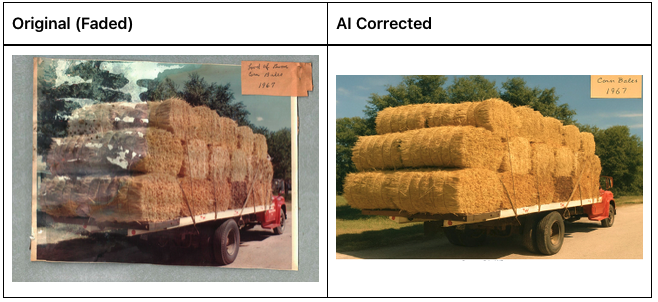
Here is another set where the original image was blurry and had significant color fade. AI assisted in stabilizing the frame and correcting the red color balance. It allowed us to turn a “maybe” photo into a definitive “yes” for inclusion in the final manuscript.
| Original (Faded) | AI Corrected |
 |  |
When AI Creates a Masterpiece (Accidently!)
Okay, this is the part I’m most excited about. Sometimes, AI makes mistakes. Cool mistakes.
While I was feeding the AI different prompt combinations of elements we need for the book’s cover art and section headers, it glitched. It took two distinct historical objects I had referenced and merged them into a singular, impossible object.
Look at this:
| The Inspiration 1 (Baca County Museum Bale remnant) | The Inspiration 2 (Broomcorn Knives for sale sign) | The Glitch Masterpiece |
 |  |  |
AI accidentally created a “Combo Broomcorn Bale Remnant and sigb”!
It took the texture and form of the actual bale remnant from the Baca County Museum (the left image) and seamlessly merged it with the graphic identity of the sign from the old Coopers Western Ranch Store in Arcola, Illinois (the middle image).
The resulting image (the glitch masterpiece on the right) features the Baca bale form, but imprinted directly onto its messy, straw texture is the graphic outline of the “Broomcorn Knives for Sale” text perfectly positioned.
It is a completely fictional, accidental hybrid object that tells two stories at once.
I am calling this the “Glitch Masterpiece.” Because it’s pretty cool and we may use this accidental AI creation in one of the books. the book! It may serve as a section divider between the Regional History and Broommaking chapters. Who knows!
When AI Doesn’t Know Its Brush from Its Ears
While AI has been a lifesaver for cleaning up our still photos, the video tools are a completely different story. We recently ran some tests to see if we could animate historical broom-making techniques, and the results were… well, a disaster.
The “broomcorn vs. AI” struggle is a classic example of the “Domain Knowledge Gap.” Because broomcorn is technically a variety of sorghum (Sorghum vulgare) and not “corn” (maize), AI video models like Veo or Sora often have a total identity crisis. If you ask for “broomcorn,” the AI usually hallucinates a bizarre hybrid: stalks of sweet corn that somehow grow household sweeping brooms instead of ears, or a field of popcorn being swept by invisible janitors.
AI still thinks Broomcorn is actually “Corn.” Despite being an “intelligence,” AI hasn’t quite grasped that broomcorn is a type of sorghum. When we asked the Gemini video tool to generate a from a picture of broomcorn johnny cutting and a picture of Budge Bishop’s broomcorn knife it didn’t give us a beautifully orchestrated johnny cutting broomcorn. Instead, it gave us:
- Exaggerated corncobs as Tassels
- Exaggerated version of Budge Bishops broomcorn knife donated to the Baca Museum by John Morrison
Why it matters: This “disaster” highlights why human oversight is non-negotiable. AI is great at pixels, but it doesn’t understand heritage. It can remove a wrinkle from a seed sack, but it doesn’t know the physical difference between the “brush” of a sorghum plant and an ear of Silver Queen.
AI is just another tool in the historian’s toolkit. Used transparently, it’s allowing us to share more of the broomcorn story, faster.
We can’t wait to show you the final product!
Here is a teaser.

Leave a Reply
You must be logged in to post a comment.