By Kent Brooks, historical context with observations from the research of Dr. Norman Kincaide

History in Baca County and Southeast Colorado is not a straight line; it is a recurring cycle of high-altitude disconnect. Recently I began reviewing the 90 year parallels between the President Roosevelt’s 1936 drought commission and the 2025 /2026 Comanche National Grassland management workshops, the echoes are fascinating. The story of the Comanche National Grasslands (CNG) began not with a local vision, but with a federal crisis. It was born from the clinical declarations of FDR’s Brain Trust—men who stood on the Springfield courthouse steps and branded this landscape “sub-marginal,” a designation that paved the way for the federal buy-back of failed homesteads and the eventual creation of the National Grasslands.
By observing the historical records of the 1936 FDR Drouth Committee alongside the modern management workshops of 2026 as reported by Norman Kincaide, it becomes clear that while the technology has changed, the fundamental friction between federal “experts” and local “survivors” remains remarkably constant.

The “spirit” of that creation was forged in a moment of profound friction. To the federal experts, it was a triumph of scientific planning. To the locals, it was the final result of a government that didn’t even know the altitude of the land it was claiming. Today, as we navigate the 2025–2026 Management Plan revisions, we find ourselves standing on those same courthouse steps, facing the same “deluge of hot air.”
The Foundation: The “FDR Brain Trust” and the Altitude Question
In August 1936, a group of President Roosevelt’s “Brain Trust” intellectuals—including Rexford Tugwell and John C. Page—arrived in Springfield to survey the “Capital of the Dust Bowl.” To the locals, they were academic outsiders who saw “fair wheat crops” from a car window and declared that things were “not so bad.”

The defining moment of that visit was Tugwell’s inquiry into the county’s altitude—a fact the government already possessed in Washington. To the residents, it was proof that federal planning was detached from local reality. This visit led directly to the federal buy-back of “sub-marginal” lands under the Bankhead-Jones Farm Tenant Act, which consolidated the very acreage that forms the Comanche National Grasslands today.
“What is the altitude of Baca county? That question asked by Rex Tugwell… so utterly exasperates us… For the past months the government has been sending its representatives into this county in droves and they all ask the same old question… According to the Geodetic Survey put out by somebody in that responsible place the altitude of Baca county is 4,366.225 feet… but the government doesn’t seem to have sense enough to refer to its own surveys.” — Springfield Democrat Herald, August 20, 1936
The 2025 Parallel: AI and Absentee Planning
Nearly a century later, Dr. Norman Kincaide’s reporting on the Cimarron and Comanche National Grasslands (CCNG) Draft Assessment reveals a modern version of Tugwell’s altitude gaffe. Instead of ignoring paper surveys, today’s planners are accused of ignoring the land itself, utilizing Artificial Intelligence (AI) and unverified internet sources rather than gathering in-person data.
Where Tugwell asked for the altitude, the 2025 Draft Assessment listed “Species of Conservation Concern” (SCC) that have never existed in the area. Both represent the same failure: a federal process that values distant, abstract data over the boots-on-the-ground reality of the people who actually live there.
The “Deluge of Hot Air”
Both eras represent a federal process that values distant, abstract oratory over the boots-on-the-ground reality of the survivors. In 1936, the local press was quick to identify the performance-like nature of federal visits.

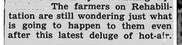
“The Great Plains Drought committee… spent about three-quarters of an hour saying ten words where one would have done, and the people who spent their time listening to them knew not one whit more when they finished than they did when they began… Congressman John A. Martin… addressed his audience as ‘fellow sufferers’… but the audience rather stupidly failed to laugh at the correct moments… the crowd is still wondering just what is going to happen to them even after this latest deluge of hot air.” — Springfield Republican, August 21, 1936

Continuity vs. Turnover: The “Ever-Changing” Federal Face
The most significant connection between these two eras is the disparity in institutional memory. As Kincaide observes, the families grazing the Timpas and Carrizzo units represent a “continuity of presence” that often stretches back over a century. They are the keepers of the land’s history.

In contrast, the Forest Service remains an “ever-changing” entity. Federal employees often rotate through the region, lacking the multi-generational relationship with the soil that the ranchers possess. This creates a cycle where the “learning process” must start over every 20 to 40 years, forcing locals to repeatedly defend their management practices against a revolving door of federal mandates.
“Mr. Tugwell, will you please tell us just why it is that when a man mortgages his property to the government… that one check comes on time, the next month’s check is cut in half, and the third month there is no check…? Mr. Tugwell’s answer to that one, friends, was: ‘I think that is being taken care of.’” — Springfield Democrat Herald, August 20, 1936
Reclaiming the Seat: The Cooperating Agency
The 1936 visit ended with the community wondering “just what is going to happen to them.” In 2026, however, the response is more proactive. Local leaders in Otero, Las Animas, and Baca counties are seeking “Cooperating Agency” status to ensure that coordination is meaningful and continuous. They are demanding that the federal government move past the “deluge of hot air” and actually coordinate with the people who nurture the land.
The Unfinished Business of Springfield and Southeast Colorado
The road from the 1936 courthouse steps to the 2026 workshops reveals an unfinished dialogue. The establishment of the Comanche National Grasslands was an artifact of the New Deal’s belief that the land was “unfit” for its people. Yet, ninety years later, those people are still there—raising cattle, maintaining the ecology, and enduring.
The ghost of Rexford Tugwell still hovers over the Comanche Grasslands. As the Forest Service moves toward a final management plan, the question for the next century remains: Will Washington finally acknowledge the “altitude” of local expertise, or are we simply witnessing a new century’s version of the same old hot air?
| Point of Comparison | The 1930s Archival Evidence | The 2025/2026 Modern Evidence |
| Federal “Expertise” | The FDR Brain Trust: Ivy League intellectuals (Tugwell, Moley, Berle) arriving by motorcade to “study” a region they had already branded “sub-marginal” from afar. | The Digital Planners: Absentee planners and independent contractors (AECOM, Dallas) producing 1,500-page “living documents” via Zoom and webinars. |
| The Data Disconnect | The Altitude Gaffe: Tugwell asking for the altitude of Baca County while standing on the courthouse steps—information the government already possessed in Washington surveys from 30 years prior. | The AI Gaffe: A Draft Assessment accused of using Artificial Intelligence and unverified internet data to list “Species of Conservation Concern” (SCC) that have never existed in the area. |
| The “Deaf Ear” | “Not So Bad”: Commissioner John C. Page seeing a “light duster” near Lamar and declaring the crisis wasn’t as bad as expected, while locals were losing $3M in crop value and fighting for survival. | “Living” Documents: A 1,500-page Revised Assessment released during calving season with limited participation, described by the USFS Chief as a document “no one reads.” |
| Communication Style | “Deluge of Hot Air”: Bernice Jackson’s observation that officials spent 45 minutes “saying ten words where one would have done,” leaving the local crowd in silent skepticism. | “Channeled” Workshops: Moderators attempting to “direct and channel” discussions during “informal” workshops where federal employees were constrained from acting outside their roles. |
| Institutional Memory | The “Drouth Tour”: A fleeting visit by political figures who viewed the High Plains as an experiment in social and economic planning. | The “Ever-Changing” Face: Rapid turnover of federal employees vs. the “Continuity of Presence” of ranchers who have managed the same allotments for over a century. |
| Local Response | “Rain Solution”: Mayor Harvey McKinnis syndicating a message to 70+ newspapers that only moisture matters—not federal “planting” or theory. | “Cooperating Agency”: Local county commissioners and ranching associations seeking legal status to force the government into meaningful, continuous coordination. |
Concluding Observation
As seen in the archives, the Bangor Daily News (1938) and The Truth (1935) proved that the eyes of the entire nation were once on Springfield. The federal government used these wire services to broadcast “successes” when the rain finally fell. Today, the struggle over the Comanche National Grasslands shows that the bureaucracy has simply traded motorcades for webinars.
The evidence suggests that the “Unfinished Business of Springfield/Baca County and Southeast Colorado” is a refusal by the federal government to acknowledge that the people who nurture the land have a more accurate “assessment” than the experts who merely manage it from behind a desk.
As we look at these yellowed archives and compare them to the digital drafts of today, we are reminded of the warning issued by philosopher George Santayana in his 1905 work, The Life of Reason:
“Those who cannot remember the past are condemned to repeat it.”
Help support our work: Check out these titles on Amazon:


Leave a Reply
You must be logged in to post a comment.