AI and the War on Memory
Be very careful what you swallow; we are living in the age of AI.

I’ve spent years preserving local history and working in IT and cybersecurity, and I never expected those two worlds to collide. But guess what—they have.
I didn’t respond to this FAKE HISTORY topic as quickly as maybe I should have. For me, history has always been a release — a place to step away from the daily pressures of IT management and cybersecurity. Seeing it distorted this way made the collision of those two worlds hard to swallow, however, it is impossible to ignore. And the problem with writing about this is simple: I can’t write fast enough to keep up with AI..without using AI.
Over the past several months, I’ve seen a number of AI-generated fake history articles on Facebook from various sources, one on Facebook which is called OLD AMERICAN LIFE – Every one of them has been false with a shiny wrapper making them look legit. Here’s part of the challenge: when an AI produces output that is grammatically perfect and confidently written, our brains instinctively lower their defenses. We conflate fluencywith accuracy. That is the definition of passive thinking—allowing the tool to bypass our judgment.
Artificial intelligence is now generating stories that sound true, feel true, and spread fast — even when they never happened. Our friend and fellow Baca Countian Steve Doner has provided some insight on this, but it is an even bigger problem with huge amounts of money attached to it. The fabricated Two Buttes Dust Bowl tragedies to a recent AI-written report by Deloitte in which allegedly cited AI-generated research supported a million-dollar report for a Canadian provincial government. It was filled with fake citations. Misinformation is no longer a fringe problem. It’s everywhere.
Beginning this week, the Plainsman Herald / Kent will launch a multi-part series exploring topics such as:
- How AI distorts history
- How false information spreads
- How it affects our digital safety
- How individuals and communities can protect themselves
- Why “verify first, trust second” matters now more than ever
These FAKE articles will discuss the preservation of our shared memory with the growing need for digital resilience in an AI-driven world. I would much rather be doing research on our share history, but we really need to discuss this and so we will
Because if we don’t guard and record the truth, someone — or something — else will rewrite it for us.
Let’s look at the FAKE AI Generated Two Buttes Story:

No child was ever killed and buried in a Dust Bowl schoolhouse collapse in Two Buttes or Baca County. There is ZERO historical record—in our local newspapers. I have reviewed the archives of both the Springfield and Walsh papers, and there are no county death records, school logs, cemetery registries, or survivor accounts—of such an event. In Baca County, where nearly every tragedy made the headlines because newspapers were the community’s lifeline, a schoolhouse wall collapsing and killing a child would have been front-page news in every Colorado, Kansas, and Oklahoma paper on the plains. It wasn’t reported anywhere, yet a Facebook group with 191,000 followers gets over 1000 likes etc and the FAKE story was shared 230 times. Folks wake up and pay attention. This will only get worse.
If no one in the county has ever heard of a supposed major tragedy, it probably never happened. – Steve Doner, Local Baca County Historian
The story describes dust behavior wrong. Dust storms may have
- Broke windows,
- Forced dirt inside through gaps,
- Piled drifts against structures,
However, they did not generate enough lateral force to knock down full walls of intact schoolhouses.
A “tidal wave of sand flooding the room” is an AI trope, not a real Dust Bowl phenomenon. “Anyone who grew up in Baca County knows there are no ‘tidal waves’ of sand during a dirt storm. Sand accumulates steadily over hours, days, or longer — not instantly.”
4. “Little House on the Prairie” wasn’t a classroom read in rural Baca County in 1934.
The book Little House on the Prairie was published in 1935, not available to be read in classrooms in 1934. This single detail is a dead giveaway of AI-generated or fabricated text.
The Two Buttes area has no burial record matching “Elsie Carter” or any comparable school death in 1934. Two Buttes had an established cemetery by 1912. Why would a community bury a child in a schoolyard?
2. Two Buttes DID have brutal dust storms—but no one-room schoolhouse disaster of this type.
Two Buttes in 1934 had:
Actual, documented dust storms Poor visibility, sickness, dust pneumonia cases.
But the town’s school buildings did not collapse in a storm, and no accounts describe a fatal structural failure.
The emotional beats follow current AI-generated fake-history patterns.
The structure checks every cliché seen in AI-fabricated “Dust Bowl tragedy” stories:
- Young female schoolteacher
- Children endangered in storm
- Innocent child death
- Buried shoe detail
- Teacher traumatized and “never taught again”
- School abandoned
- Rural community tragedy “lost to history”
- These are storytelling tropes, not historical reporting
It’s AI trained on:
- Grapes of Wrath
- 1930s melodrama
- Viral Facebook “historical tragedy” posts
- Gothic-Americana fiction
None of this aligns with documented rural life in Baca or Prowers counties.
8. Two Buttes wasn’t “where the dust didn’t fall like snow.”
The story ends with:
“The children were sent to towns where the dust didn’t fall like snow.”
In 1934, dust was everywhere across the High Plains.
No nearby town offered refuge from it and these people wouldn’t have given up their children in mass This isn’t history. It’s fiction generated by a machine with no understanding of place, people, or truth.
And here’s the part that bothers me most.
These fake histories—no matter how dramatic—wash out the real struggles people actually faced. They make the Dust Bowl seem like a series of spectacular tragedies instead of what it really was: a long grind of doing whatever you had to do to survive.

My own family’s history is proof of that. On social media I’ve shared the exciting pieces of family history—my granddad’s time with the sheriff’s office, the photos with Orville Ewing, the images from the JJ Ranch. Those stories matter, and I’m proud of them. But they’re not the whole picture.
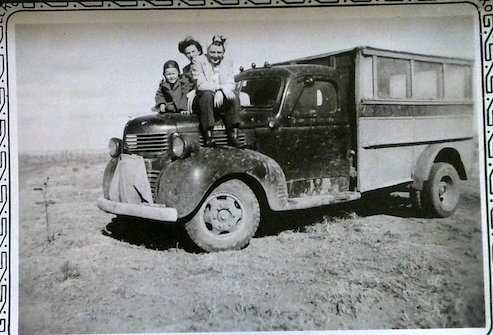
In the 1930s, when times were truly hard, my granddad drove a bus route. It was their only steady income. When he fell seriously ill and couldn’t work, Burnice Chandler stepped in. He drove the route for him and gave the money directly to my grandmother so the family could make it through.
- No dramatics.
- No roaring dust wave.
- No invented tragedy.
- Just one neighbor helping another in a moment when every dollar counted.
That’s the kind of story that never goes viral.
But it’s the kind of story that actually built this place.
“Every one of these stories carries an implication that Dust Bowl parents were negligent, helpless, or incapable. That implication isn’t just wrong — it’s offensive to the people who lived through those years.” – Steve Doner, local historian
The danger of AI-generated fiction is that it drowns out these quieter truths—the ones that tell us who people really were, what they endured, and how they helped each other survive. If we let fabricated melodrama replace memories like this, we lose something far more valuable than historical accuracy. We lose the humanity at the heart of our past.
Leave a Reply
You must be logged in to post a comment.