The years 1934 and 1935 were arguably about as tough as the Dust Bowl ever got in Baca County. The country was dry, crops were failing, dirt was moving and times were already plenty hard without Mother Nature piling on. Yet buried in the newspapers from those two years is a curious part of the Baca County Dust Bowl story. While much of the country was drying up, broomcorn sometimes managed to hang on.
Years ago, when I interviewed longtime Baca County broomcorn man Bill Greathouse, he told me something that has stuck with me. During the Dust Bowl years, he said, they always had a broomcorn crop. Maybe not a good crop everywhere and certainly not every farmer, but somewhere in the county they seemed to raise some broomcorn. The newspapers from 1934 and 1935 make it look like Bill remembered it just about right.

A Rain at Just the Right Time
Broomcorn hadn’t been worth much going into 1934. The Nebraska Farmer later reported that Baca County broomcorn had brought only $34 a ton the previous fall. Farmers were described as gloomy and discouraged, with many receiving relief. The 1934 crop didn’t look very promising either.
Then, late in August, it rained. For a lot of crops the rain came too late, but not for broomcorn. At the same time, drought had hurt broomcorn production elsewhere, leaving less brush on the market. Baca County happened to have some to sell just when everybody else needed it. By November, The Nebraska Farmer reported that the county had about 2,500 tonsof broomcorn and farmers were getting $200 a ton for it.
From $34 to $200 a ton. That will change the mood around town in a hurry.
The Buyers Came Looking
A couple of weeks earlier, The Lindsay News in Oklahoma had printed an interesting report from “Mr. Denning,” who had returned from several weeks traveling through the Southwest. This would have been the noted broomcorn buyer John Denning Sr., Denning estimated the Baca County crop at somewhere between 225 and 300 railroad cars and said about 75 percent had already been sold.
But it is his description of the buying activity that really catches my attention. “There are lots of buyers at Walsh, Colo.,” Denning reported. “The town has taken on the appearance of Lindsay during the busy buying season.”

That was saying something. Lindsay, Oklahoma, was already one of the established centers of the American broomcorn business. Here was a man who knew that business looking at what was happening in Baca County and comparing it to Lindsay at the height of buying season. The buyers were coming because the broomcorn was here. Hundreds of railroad cars were needed to haul it away, and most of the crop had already changed hands by early November.
Denning also reported that buying was difficult because there were a lot of sticks and spikes mixed in with the brush. The explanation in The Lindsay News was probably more revealing than anybody intended: “The growers are not leaving anything in the field that looks like broom corn.”
At $200 a ton, can you blame them?
Broke One Month, Paying Taxes the Next
By December, Baca County’s strange bit of good fortune was making newspapers around the country. The Sacramento Bee carried a story headlined “Broom Corn Brings Wealth In Colorado.” It reported that Baca County farmers who had recently been “broke and receiving relief” were now studying their income tax forms and figuring they might owe Uncle Sam some money come March.
The newspaper summed up the reason in one short sentence: “Broom corn is the reason.”

The story explained that the crop had looked like a failure early in the summer before the late-August rain arrived. Drought elsewhere then cut the supply, sending prices from around $95 to as much as $200 a ton. By early December, several hundred carloads of broomcorn had already been shipped out of Baca County. A few days later essentially the same wire story appeared in the Fort Worth Star-Telegram under the headline “BROOMCORN BOON TO COLORADO FARMERS.”
Not bad publicity for a county in the middle of the Dust Bowl.
When the Crop Was Worth More Than the Farm
Then there was the fellow who bought a half section of Baca County land for $7.50 an acre. A half section is 320 acres, so he had about $2,400 invested in the place. According to The Lindsay News, nearly $13,000 worth of broomcorn was raised on the land in 1934. The owner was receiving a one-fourth share of the crop, which meant his share from one year’s broomcorn brought him more cash than he had paid for the whole 320 acres.
The newspaper didn’t dance around what had happened. Its headline said the farmers had made a “Killing” on Broom Corn. For at least a few Baca County farmers in 1934, that wasn’t much of an exaggeration.
“No Crop Flop Ever Complete”

Then I came across an article that made me think again about what Bill Greenhouse had told me.
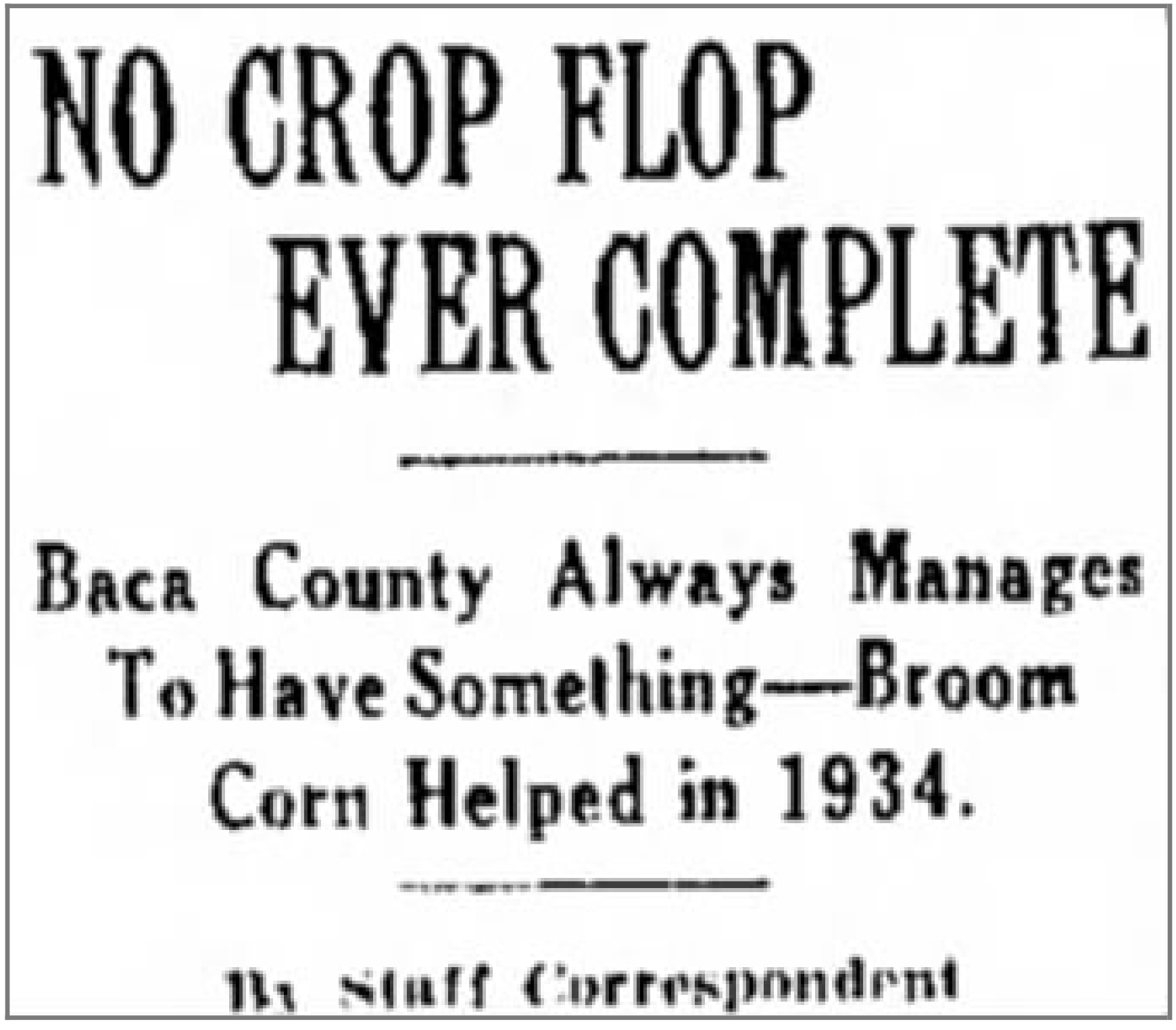
On April 3, 1935, the Hutchinson News sent a correspondent into Baca County. Remember the date. Baca County had just gone through the terrible year of 1934, and another of the toughest years of the Dust Bowl was getting underway. Yet the headline over the story was “NO CROP FLOP EVER COMPLETE.” The subheading made the point even clearer: “Baca County Always Manages To Have Something—Broom Corn Helped in 1934.”
The reporter found that while people elsewhere might talk about Baca County having suffered a complete crop failure, the people who actually lived here didn’t see it quite that way. Will Hancock, who farmed southwest of Walsh, said 1934 had been his best crop year in ten years. A timely rain happened to hit his place, and Hancock reportedly sold $16,000 worth of broomcorn. G. G. Scott, south of Walsh, marketed about 60 tons at $225 a ton.
That tells us something about the Dust Bowl that can get lost in the larger story. Rain didn’t fall according to county lines. One farmer might watch his crop burn up while another fellow a few miles away caught the right thunderstorm at the right time. The county could have a terrible crop year without every farm being a complete failure.
The old-timers interviewed by the Hutchinson News made that point themselves. C. S. Lane had been farming in Baca County for 27 years and said he’d seen only three crop failures. Then he qualified even that. They weren’t really total failures, he said, because “Every year there has been something raised, a crop of some kind.” Banker R. R. Holt told much the same story. During his years in the county, Baca County had practically always shipped something out—grain, livestock or broomcorn.
“All We Need Is Rain”
Baca County Always Manages
To Have Something—Broom
Corn Helped in 1934.
By Staff Correspondent

WALSH, Colo., April 1—It’s nearly every one for himself in this country. That may follow in this country. Take last year, for instance. People referred to Baca county having had a total failure last year.
But ask Will Hancock, farmer southwest of here, and he’ll tell you that 1934 was the best crop year he has had for ten years. It just happened so. A timely rain which seemed to miss others, hit his place, and although generally speaking Baca county had a crop failure last year Bill Hancock sold $16,000 worth of broomcorn. And it was really his first good crop in ten years.
Then there’s G. G. Scott, south of here, who marketed about 60 tons of broomcorn last year at $225 per ton.
“There was quite a strip of country south of here that had timely rain last year and the farmers made more on broomcorn than for several years,” crops selling all the way from $1,000 to $15,000 or more,” explained R. R. Holt, president of the bank here.
March Old Rush
Jas. Tryon had 70 acres of broomcorn last year, and he marketed 75 tons of brush to the acre [this appears unclear in the clipping and may read differently]. And the Tryon brothers harvested something like $20,000 worth of broomcorn in the last twelve months, including some they had held over from former years.
So it wouldn’t be fair to say that any year is a total failure in Baca county. It may be admitted, however, that unless some rains come soon, this may be one.
“It’s ten years however to give up,” insisted C. S. Lane, who works at the Chevrolet agency, but has been farming in Baca county for 27 years. “If we get rains here any time between now and June we can get in a row crop.”
Three Ahead Of Town
Lane came here in 1908. That was before Walsh was started, and before the railroad was built. The first train came through in 1927. So Lane is a pioneer, in a way.
“Out of 27 years here I’ve only seen three crop failures,” he declared. “And they weren’t really total failures. Every year there has been something raised, a crop of some kind. I guess 1931 and 1934 have been the worst. I don’t know any reason why anybody should give up and leave here. Everything seems to get a little better economically. It’s the land’s fault one of 27? That’s right? a pretty good batting average.”
Talking land, who has been running banks, land growing crops in this county for 20 years, remarked that the practically every year in his time, Baca county has shipped grain, livestock, and broomcorn.
“A world of stuff has gone out of this county in feed the world,” said Holt. “Just because we have a year or two of short crops doesn’t mean we haven’t crops always grown plenty of stuff for ourselves. Last year was the first time in the history of the county that a carload of hay had to be shipped in here.”
A Growing Town
Holt settled in what is Springfield, the county seat, in 1914. In 1916 he opened a bank at Stanton. That was long before there was a railroad in the county. Something was a good town then.
When the Santa Fe built through Baca in 1926 the town of Walsh was started, and the bank and other business concerns at Stanton moved to Walsh. The town was started in October, 1927, a little over seven years ago.
It’s a lively youngster, with a good hotel, nice brick buildings, fine school, elevators, and a big shipping center.
As to the crop outlook for this year—well, here’s the way Banker Holt sees it:
“There’s a little wheat still alive in the southeast part of Baca county, south and east of Walsh. Give us rain by the middle of May and we’ll have a row crop and broomcorn crop. All we need is rain.”
There is something else about that April 1935 story I like. The men being interviewed had no idea how history was going to remember 1934 and 1935. They didn’t know that generations later we would look back on those years as perhaps the worst of the Dust Bowl in Baca County. They were simply looking at dry fields and wondering whether it was going to rain.
And they weren’t ready to quit.
Looking ahead to the 1935 crop, Holt figured that if they could get rain by the middle of May, there was still time to make a row crop and a broomcorn crop. His prescription for Baca County agriculture was pretty simple:
“All we need is rain.”
Every dryland farmer who has ever kicked the dirt in southeastern Colorado probably understands that sentence.
Was 1934 a Turning Point?
There is another reason I find these clippings interesting. I’ve spent quite a bit of time trying to pin down when Baca County really became the Broomcorn Capital of the World. There probably isn’t one day when somebody could have driven a stake into the ground and said, There. It happened today. But 1934 is looking more and more important.
The railroad had come into Baca County in 1926, and the county was already raising a lot of broomcorn before 1934. But look at what was happening by that fall: hundreds of carloads of broomcorn, buyers coming from outside the county looking for it, three-fourths of the crop already sold by early November and newspapers across the country writing about Baca County broomcorn.
And then there is John Denning’s comparison to Lindsay.
That’s the part that catches my attention. Baca County wasn’t just becoming a place that grew a lot of broomcorn. It was becoming a place where the broomcorn business happened.
I don’t know that I’d crown Baca County the Broomcorn Capital of the World in 1934. But I think you can see the crown coming.
They Always Had a Broomcorn Crop
Which brings me back to Bill Greenhouse. When he told me that they always had a broomcorn crop during the Dust Bowl, I took note of it. After finding these newspaper accounts, I have a better appreciation for what he meant.
Here was Baca County in 1934, one of the toughest years of the Dust Bowl. People were on relief, crops were failing and the country was dry. Yet Baca County shipped hundreds of railroad cars of broomcorn. One farmer reportedly sold $16,000 worth. Another sold 60 tons at $225 a ton. Another piece of land produced enough broomcorn that the owner’s quarter share brought in more than he’d paid for the farm.
Then came 1935, another brutal year, and Baca County farmers were still looking at the sky and figuring that if they could just catch a rain, there was time to put in another broomcorn crop.
None of that makes the Dust Bowl any less terrible. What it does is help explain why broomcorn became such a big part of Baca County’s story. Broomcorn was certainly good in the good years. Sometimes it was the crop that was still there in the bad ones.
And when Bill Greathouse looked back on those years and told me they always had a broomcorn crop, he wasn’t just remembering it that way. The newspapers were saying much the same thing while the dust was still blowing.

Want to learn more about Old Boston Colorado? Find it and our other titles on Amazon:


Leave a Reply
You must be logged in to post a comment.