
Author’s Note: A Living Archive
My work on this began with a singular focus: recording the history of the place where I grew up, Baca County Colorado. I have been and am primarily interested in the preservation of the raw, unfiltered history of the High Plains and Baca County and ensuring the 1930s “Decade of Dirt” is never forgotten. However, as I spent the past few months working on the accounts of the 1936 federal visit to the Springfield courthouse steps in our papers archives, I couldn’t help but notice a striking parallel to the work of Dr. Norman Kincaide‘s writing regarding the current management battles over the Comanche National Grasslands,
I realized history often connects to the present and I found I was looking at a mirror. My observation is that the governments “deluge of hot air” that exasperated Baca County residents in 1936—and the ignored local pragmatism of 1935—is echoing in the webinars and draft assessments of 2025 and 2026. This is part history and part an observation of how the seeds of federal disconnect planted ninety years ago are still bearing fruit today. Those observations in a separate article but first, back to 1936.
The Prevailing Dust Bowl Narrative

The prevailing narrative of the Great Depression, the “Dust Bowl” is frequently synonymous with the Oklahoma and Texas Panhandles. Popular media and major documentaries, such as Ken Burns’ The Dust Bowl, often lean heavily on the “Okie” migration and the trials of those specific regions. While their suffering was immense, this focus has inadvertently pushed Colorado’s role to the periphery of American historical memory.

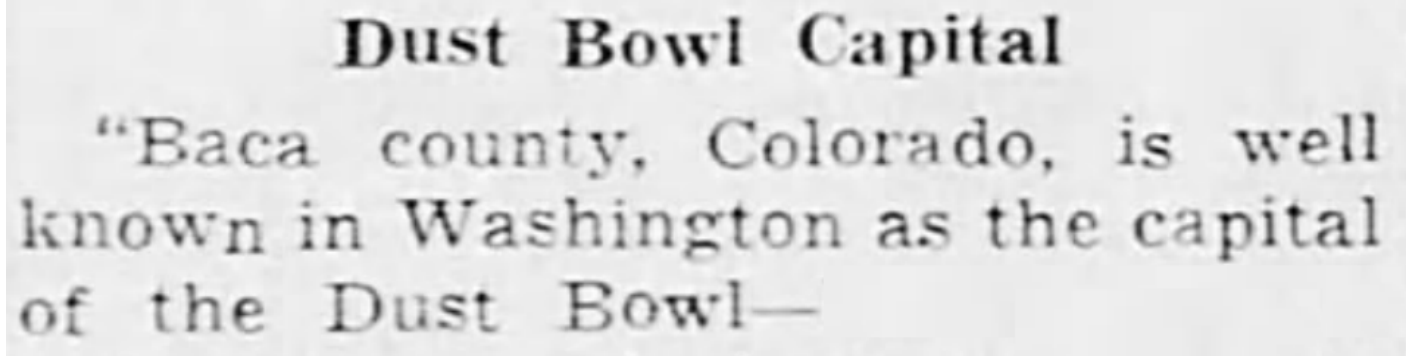
The research compiled in this project serves as a primary-source correction to this geographical oversight. In August 1936, when the President’s Drought Committee arrived in Springfield, they weren’t visiting a secondary site; they were visiting what the federal government and the national press—from Illinois to Ohio—openly called the “Capital of the Dust Bowl.”
While Tim Egan’s The Worst Hard Time correctly included the narrative on the “High Plains” and the unique, harrowing devastation of Baca County through the Ike Osteen story, the broader public still largely ignores the Colorado dust bowl story. By leading with these 1936 archives, this narrative includes Baca County Colorado to its rightful—if tragic—place at the center of the story. These records prove that for the “Brain Trust” and the nation in 1936, the road to understanding the environmental collapse of the decade ran directly through Southeast Colorado.

Based on the provided documents, the following members of President Roosevelt’s Drouth Committee were present in Baca County, Colorado, during the August 1936 visit:
Confirmed 1936 Drought Committee Members in Baca County
Rexford Guy Tugwell: Tugwell along with Hugh Bennett is one of most prominent committee members, met with farmers on the courthouse lawn in Springfield in 1936. His visit is noted by locals for his specific inquiry regarding the county’s altitude. Additionally, most of the Library of Congress photos taken that day at the Baca County County courthouse by famed Dust Bowl Photographer Arthur Rostein included Tugwell.
Morris L. Cooke: The chairman of the Drouth Survey Committee. He was introduced by Congressman Martin during the meeting on the courthouse lawn.

H.H. “Hugh” Bennett: Chief of the Soil Conservation Service in Washington. He was introduced as one of the nation’s outstanding soil experts.
John C. Page: Acting commissioner and chief engineer of the Bureau of Reclamation.
Col. F.C. Harrington: Assistant administrator and chief engineer of the Works Progress Administration (WPA).
Col. Richard C. Moore: U.S. Army Division Engineer for the Missouri River division.

Lewis C. Gray: Head of the Land Utilization Division of the Resettlement Administration.
Additional Notable Figures Present
Congressman John A. Martin: Served as the chairman for the informal meeting held on the courthouse lawn in Springfield where the committee members were introduced.
Arthur Rothstein: A photographer who documented the visit, capturing images of Tugwell conferring with farmers in Springfield.
The committee reached Baca County by motoring from Amarillo, Texas, and Dalhart, Texas, eventually continuing their itinerary to Lamar, Colorado, and Scott City, Kansas.
The Pragmatic Prelude: Springfield 1935

The Truth (Elkhart, Indiana) Wed, Mar 27, 1935.
Authors Note: By including the 1935 perspective of Mayor Harvey McKinnis, I am highlighting a local truth that existed before the federal intervention: that the people who lived the crisis understood its mechanics far better than the experts who eventually arrived to study them.
When Mayor Harvey McKinnis penned his plea for rain in March 1935, he was speaking to the nation. The fact that his words appeared in over 70 instances from coast to coast proves that the American public was hungry for the truth from the ‘pivotal point’ of the disaster. While the FDR Brain Trust later attempted to frame the narrative through academic planning, the archives show that the national conversation began with the local pragmatism of a small town Colorado mayor.
It Comes down to Rain
In March 1935, a full year before the FDR Brain Trust motorcade arrived in Baca County, Springfield Mayor Harvey McKinnis became a national voice for local reality. His voice heard in newspapers from, from the west coast to Maine, offered a stark counter-narrative to the burgeoning federal bureaucracy in Washington.
While experts in the capital were drafting “scientific” soil erosion plans, McKinnis was blunt about the limitations of policy without moisture. “I don’t think any kind of planting will be effective until moisture restores the soil,” he wrote. For the survivors of Springfield, salvation wasn’t a matter of federal “intellect”; it was “largely a matter of rain.”
McKinnis described a community that reached the point of packing their wagons, only to “back down and decide to stick,” waiting for the only resource the government could not provide. This stubborn local pragmatism establishes the baseline: the people of Baca County were waiting for clouds, while Washington was preparing According to Bernice the Springfield Republican a “deluge of hot air.”

Despite the “plenty tough” conditions and the “blues” that led many to talk of moving away, the Mayor spoke of a profound local stubbornness. While some departed, many more reached the point of packing their goods only to “back down and decide to stick”. They remained convinced that sizable crops would return “if the rain, always the rain, comes”. This 1935 portrait of resilience serves as a critical precursor to the 1936 visit of FDR’s “Brain Trust,” illustrating a community already weary of theory and waiting desperately for the only resource the government could not provide.
Baca County were waiting for clouds, while Washington was preparing a “deluge of hot air.”
The Local Reaction: Frustration and Skepticism Salvation

While Tugwell held a high national standing, his visit was met with significant local skepticism, documented in the pages of Springfield’s Democrat Herald. Even before the official committee reached Springfield, federal “experts” were forming clinical conclusions. Traveling by motorcade from Texas, committee members—including Tugwell, Morris Cooke, and John C. Page—encountered a “light duster” near Lamar that was quickly followed by rain. This brief weather event seemingly colored their assessment; upon arriving in Springfield, Commissioner Page remarked that “things are not so bad as we had expected”.
As the motorcade crossed from the Oklahoma Panhandle into Colorado, the Henryetta Daily Free-Lance reported that the commission—which included Tugwell, Morris Cooke, and John C. Page—encountered a “light duster” near Lamar, followed quickly by a rain that “washed the skies clear.” This fleeting glimpse of weather likely colored the commission’s clinical assessment; upon arriving at the “Dust Bowl Capital,” Commissioner Page offered the terse observation that “things are not so bad as we had expected.” To the federal eyes peering through limousine windows at what they described as “fair wheat crops” along the route, the crisis was a manageable problem of land management. To the farmers standing on the Springfield courthouse lawn, however, this perception was a bitter pill. Page’s additional comment that the dry farm areas simply were not “irrigation conscious” further underscored the growing divide: Washington saw a lack of modern technique, while Baca County saw a lack of survival.
One point of contention was the repeated inquiry into a seemingly simple fact: the altitude of Baca County. A local commentator expressed exasperation that high-ranking federal officials and their representatives continually asked the same question, neglecting their own government surveys. The Geodetic Survey was cited as listing the county’s altitude as 4,366.225 feet above sea level. The persistence of the question became a symbol of Washington’s perceived disconnect from local realities.
Furthermore, Bernice Jackson’s report on the Great Plains Drought Committee meeting in the August 21, 1936 Springfield Republican noted that the officials “spent about three-quarters of an hour saying ten words where one would have done.” The local audience was left unsatisfied, “still wondering just what is going to happen to them.”


This frustration culminated in a farmer’s direct, yet unanswered, query to Tugwell regarding government non-payment on mortgages and the refusal to release property so the farmer could dispose of it. Tugwell’s only response was the terse reassurance: “I think that is being taken care of.”A Lasting Legacy


Above: Rothstein, Arthur, photographer. Meeting on courthouse steps. Baca County, Colorado. Drought committee. Colorado United States Baca County, 1936. July-Aug. Photograph. https://www.loc.gov/item/2017761038/.
Despite the friction during his 1936 visit, Tugwell’s commitment to public service continued. In 1941, he was appointed Governor of Puerto Rico, where his ambitious reforms were aimed at modernizing the island’s economy and improving living conditions.

The Bangor Daily News (Bangor, Maine) · Sat, Oct 15, 1938 ·
Tugwell remained a staunch advocate for central economic planning throughout his life, arguing that government regulation was essential to prevent the economic excesses that led to the Great Depression. He passed away on July 21, 1979. His life’s work remains a powerful testament to the impact of visionary thinking on public policy and continues to offer valuable lessons to policymakers grappling with the pursuit of a fair and just society.
The Long Shadow of the Dust Bowl
By 1938, the aggressive soil conservation efforts championed by the 1936 committee began to show results, but they did so only because the environment finally offered a reprieve. As reported in The Bangor Daily News, a wire story that was published across the United States reports a four-inch rain—something no federal policy could legislate—allowed the “survivors” of Baca County to hold their first county fair in eight years.
The statistics remained a staggering testament to the years of federal delay and local suffering: crop values had plummeted by nearly $3 million since 1929. The report captures a poignant reality of the government’s slow response—an entire generation of children had grown up in the “Dust Bowl Capital” without ever seeing a simple rain-made mud puddle.While federal experts used this moment to encourage a shift from farming to ranching to “beat the dust,” the recovery was bittersweet. It served as a “Bridge of Hope,” yet it also reinforced the local belief that Washington’s “intellectual” solutions only worked when nature allowed them to. For the people of Springfield, 1938 wasn’t just a triumph of New Deal policy; it was a hard-won breath of air in a century-long struggle to make a distant government hear the reality of the High Plains.

The branding of Baca County as the “Capital of the Dust Bowl” by Washington officials in 1936 was a label that refused to wash away with the eventual rains. This identity became a permanent fixture in the American consciousness, resurfacing with a sense of dark irony decades later. As seen in The Circleville Herald above, the title had transitioned into a piece of grim folklore. The paper noted with a dry wit in 1955 that while storms continued to “ravage the old dust bowl sectors,” no cities were currently “feuding over the honor” of reclaiming the title. What began as a clinical designation during Tugwell’s 1936 visit had matured into a legacy that the region, despite its resilience, could never quite outrun.
Help support our work: Check out these titles on Amazon:


Leave a Reply
You must be logged in to post a comment.