
“Back when information was hard to copy people valued the copies and took care of them. Now, copies are so common as to be considered worthless, and very little attention is given to preserving them over the long term. “(Brandt, 2003)
—-Danny Hillis (NOTE: I left this broken link in my original article to emphasize the point in this post)
There is a quiet assumption behind many modern policy debates: if something exists online, it must be permanent.

History — and anyone who has ever tried to find an old government webpage — tells us otherwise.
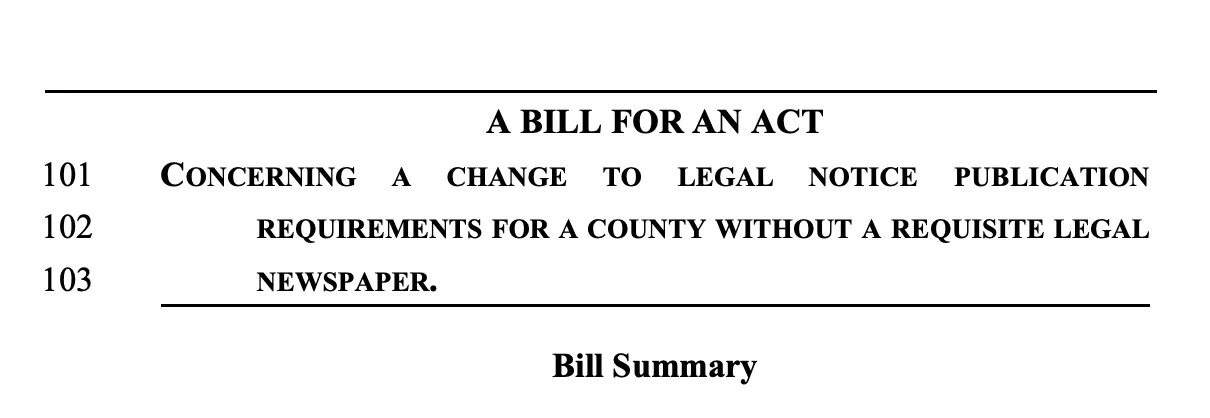
Colorado lawmakers are currently considering changes to public notice law that would allow certain notices to be posted solely on government websites and declared legally sufficient. Supporters frame the proposal as modernization, a response to shrinking newsrooms, rising costs, and the growth of news deserts across the state.
Modernization is necessary. Communities evolve. Technology changes.
But modernization that forgets the lessons of the past risks creating what might best be called Internet Amnesia — a system where records exist briefly, move quietly, and disappear when platforms, priorities, or administrations change.
This is not a new concern for me. More than a decade ago, I wrote “Are You Ready for the Digital Dark Age?” warning that while our ability to store information keeps expanding, our ability to retrieve it decades later may actually decline. Digital preservation is not just about saving files; it requires continuous migration, funding, and expertise — resources that even professional archivists struggle to maintain.
For more than a century, public notices have relied on independent newspapers as a third-party publisher. That structure was not designed to protect an industry; it was designed to protect the public record. Courts depend on affidavits of publication. Property owners depend on verifiable notice. Communities depend on an archive that exists outside the control of the government issuing the notice.
The proposed amendment would allow governments, under certain conditions, to declare their own websites sufficient for legal publication. Even if intended as a limited solution for areas without a newspaper, the language is broad enough to raise serious questions about independence and long-term recordkeeping.
Government websites are important tools. They should expand access, not replace independent verification.
Anyone who has worked in public records understands how fragile digital systems can be. Websites are redesigned. Links break. Documents move. Entire databases vanish during software migrations. The lifespan of digital media itself can be surprisingly short, and formats can become unreadable even when the data technically still exists.
That is not a hypothetical concern. Rural communities have watched digital archives disappear with little warning, leaving gaps in local history that may never be filled again.
Public notices are often overlooked because they are not flashy headlines. Yet they represent some of the most consequential decisions in civic life — foreclosures, zoning changes, elections, probate proceedings, and property rights. When disputes arise years later, the question becomes simple and serious: Can you prove the notice existed?
Independent publication has long provided that proof.
There is another proposal before lawmakers that takes a different approach — requiring legal newspapers to make notices available online without paywalls while preserving the independent publication model. That path recognizes the need for greater digital access without sacrificing the safeguards that prevent self-publication from becoming the only record.
This debate for me should be about understanding technologies limits.
The internet remembers many things — until it doesn’t.
Communities like ours know the value of records that endure beyond political cycles and software upgrades. The books below are partly a result of the historical records of this publication. Without public notices this publication will no longer exist. The public record should not depend solely on the entity being noticed, nor should it rest entirely on digital platforms that may change with little warning.
Modernize access. Expand visibility. Use every tool available.
But do not trade independent publication for Internet Amnesia.
Because once the record fades, it is far harder to restore than it was to preserve.
Help support our work: Check out these titles on Amazon:


The Area
Leave a Reply
You must be logged in to post a comment.