A recent Facebook post by Steve Doner shared a brief Springfield Herald clipping (below) dated January 12, 1900, documenting trapping activity along the river in southeastern Colorado. That short notice, combined with a comment recalling wolf trapping by Kent Homsher’s grandfather, prompted a return to the archives and to earlier research I conducted several years ago.
Long before Baca County was created in 1889, wolves were already a familiar—and often unwelcome—presence across the southeastern Colorado prairie. Frontier newspapers, personal recollections, and county records together reveal a continuous record of prairie wolves, commonly called “loafer wolves,” from the open range era through the early twentieth century.
Rather than isolated sightings, these sources document sustained interaction between people and wolves: following wagons, preying on livestock, forming packs, and eventually becoming the subject of formal county bounties.
“Loafer Wolves” Near Old Boston (Pre-1889)
The earliest account considered here dates to the period before 1889, when Old Boston lay within Las Animas County. In frontier usage, the term “loafer wolf” was another name for the prairie wolf, describing animals that lingered near settlements and wagon routes rather than avoiding human activity.
A narrative account—likely originating in a Trinidad-area newspaper (I will find the source but have misplaced at the moment)—captures this behavior vividly:
“There were lots of loafer wolves here, then too. The last one I shot I saw in my yard, before sun-up, just as it was breaking day. I got it with a shot gun. They were gentle, not much afraid of people. Would come right up to buildings, and even follow you. They had more nerve and were smarter than coyotes. You could see them any time, from two to a dozen to a bunch. Once when my brother Wade and I were going to old Boston after a load of posts and along near Bangerter’s present place we looked back to see a loafer trotting along behind the wagon. We boys were certainly scared. We didn’t know what to do, but finally threw him our lunch and he ate it and quit following. Of course he had probably learned that a wagon meant scraps thrown out, sooner or later. Freighters and campers had taught the wolves that. Even coyotes and wildcats knew the same thing and would draw near the wagons at night, where you could sometimes hear them snarling and fighting over bones.”¹
This account reflects a time when prairie wolves were woven into daily life along the wagon roads—bold, observant, and shaped by constant exposure to freighters and settlers.
Packs of Gray Wolves, 1902
Two years later, wolves were still common enough to be encountered in groups. A 1902 clipping recorded:
“T. G. McMullen and W. E. Hughes found a pack of six gray wolves south of here last week. Each of the boys succeeded in running down and killing one of these stockmen’s pests.”³
The reference to a pack of six confirms that wolves were not yet marginal or rare in the region.
Wolves and Sheep Losses, 1905
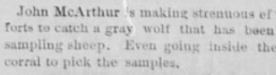
Livestock depredation continued into the new century. In February 1905, the Carrizo Miner reported active efforts to capture a gray wolf preying on sheep:
“John McArthur is making strenuous efforts to catch a gray wolf that has been sampling sheep. Even going inside the corral to pick the samples.”⁴
The wording suggests both persistence and boldness on the part of the wolf, reinforcing earlier descriptions of prairie wolves comfortable operating close to human activity.
Wolves Still Reported in 1912
By 1912, wolves remained a matter of concern. Another clipping noted:
“H. E. Homsher visited at Wilson’s a few days. Herb’s main purpose was to get sight of three or four big gray wolves that have been in that locality for some weeks. The trip was without results.”⁵
Even unsuccessful searches demonstrate that wolves were still being tracked and discussed more than a decade after the 1900 trapping report.
County Bounties Through 1914
Official county records provide the clearest evidence that wolves and coyotes remained a recognized problem. Proceedings of the Baca County Board of County Commissioners from November 1913, published in 1914, included a budget appropriation for:
“Bounty on Wolves and Coyotes … $125.00.”⁶
The presence of this line item among standard county expenses—alongside courts, roads, and schools—confirms that predator control was still publicly funded well into the 1910s.
Language, Memory, and Continuity
Taken together, these sources establish a continuous record of wolves in southeastern Colorado from the pre-Baca era through at least 1914. They also preserve the language people used to describe what they saw. “Prairie wolf” and “loafer wolf” were practical terms rooted in observation, not scientific classification.
Far from disappearing abruptly, wolves lingered—following wagons, sampling sheep, forming packs, and eventually being written into county budgets—before fading from everyday life on the High Plains.
Unknown Trinidad-area newspaper, ca. pre-1889; clipping in author’s collection.
Springfield Herald (Springfield, CO), January 12, 1900, p. 1.
Springfield Herald (Springfield, CO), 1902, exact date unknown.
Carrizo Miner (Carrizo, CO), February 1905.
Springfield Herald (Springfield, CO), 1912, exact date unknown.
Baca County Board of County Commissioners, “Proceedings,” November 3–4, 1913; published 1914.
The Writers Note on Terminology
“Loafer wolf” is a historical, colloquial term used interchangeably with prairie wolf in frontier-era newspapers and personal accounts. It describes wolves that lingered near settlements or wagon routes to scavenge food and reflects observed behavior rather than a distinct biological species.



Leave a Reply
You must be logged in to post a comment.